
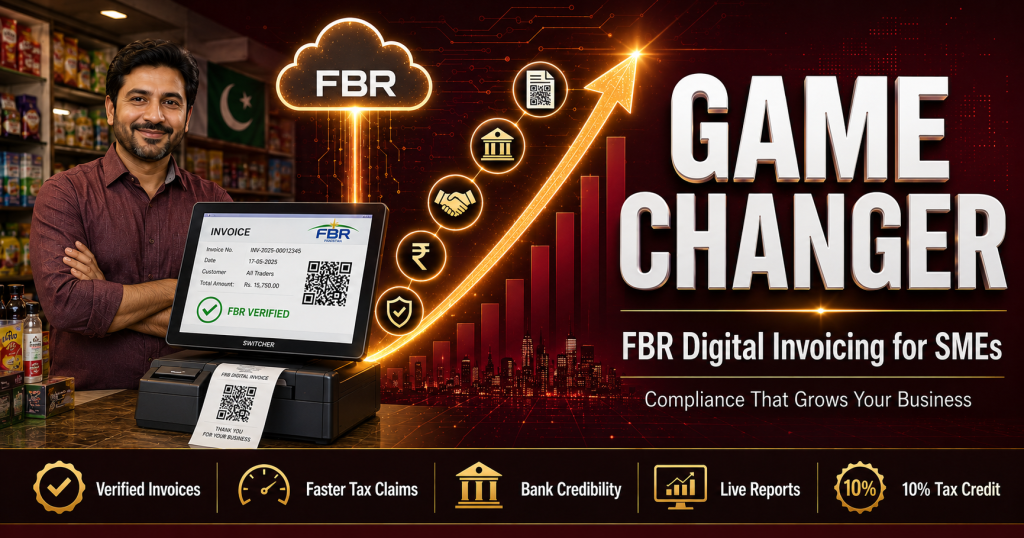
Most coverage of FBR digital invoicing focuses on deadlines, penalties, and enforcement — and yes, those are real. But for Pakistan’s small and medium-sized businesses, there’s a side of this story that rarely gets told: digital invoicing integration is quietly becoming one of the best things to happen to organized SMEs. From automatic documentation and faster input tax claims to real-time business insights and even a 10% tax credit on your setup investment, here’s why smart SMEs are treating integration as an upgrade — not a burden.
Key Takeaways
- FBR digital invoicing connects your POS or ERP to FBR in real time — every sale gets a unique FBR invoice number and QR code, and your records build themselves.
- For SMEs, the hidden wins are big: verified invoices, smoother input tax claims, cleaner books, and credibility with banks, suppliers, and corporate buyers.
- Compliant businesses gain a level playing field — undocumented competitors are losing the pricing advantage they built on evaded tax.
- The Finance Act 2026 offers a 10% tax credit on eligible integration investment — the government is effectively subsidizing your upgrade.
- Integration is simpler than most SMEs think: the right FBR-ready software plus the licensed integrator process, and your billing works exactly as before.
What is FBR digital invoicing — in one minute
FBR digital invoicing (e-invoicing) connects your billing system — POS, ERP, or invoicing software — directly to FBR’s computerized system. Every sale is reported in real time and returns a unique FBR invoice number with a QR code printed on the receipt. Customers can scan the code to verify the invoice instantly, and your sales data flows into FBR’s system as you trade.
It’s mandatory for a growing list of businesses under the phased rollout — and after the enforcement wave of 2026, essentially every sales-tax-registered SME is either already required to integrate or will be soon. For the complete picture of who must integrate and how the system works, see our complete FBR digital invoicing guide.
That’s the compliance side. Now the part that matters for your business.
7 ways digital invoicing is a game changer for SMEs
1. Your documentation builds itself
The biggest operational cost of being an SME in Pakistan isn’t tax — it’s the chaos of undocumented records. Sales in a register, purchases in a diary, receivables in someone’s memory. With digital invoicing, every sale is recorded, structured, and stored automatically the moment it happens. Month-end stops being an archaeology project.
2. Faster, cleaner input tax claims
Every FBR-verified invoice you issue is visible to your buyer for input tax adjustment — and every verified purchase invoice you receive supports your own claim. No more disputed invoices, no more “your supplier’s invoice doesn’t verify” surprises at return time. For B2B SMEs, this alone changes cash flow.
3. Corporate buyers now prefer compliant suppliers
Large companies and public-sector buyers are themselves integrated — and increasingly avoid suppliers whose invoices don’t verify, because it threatens their own input tax. A compliant SME with QR-verified invoices becomes the safer vendor to buy from. Compliance is turning into a sales advantage.
4. A level playing field — finally
For decades, documented SMEs competed against rivals who priced lower by evading tax. That gap is closing fast: with real-time reporting, buyer verification, and enforcement actions like registration suspension and green channel removal for non-compliant importers, the undocumented discount is disappearing. Businesses that invested in doing things right stop being penalized for it.
5. Real-time visibility into your own business
Here’s the irony: the data FBR wants is the same data you need. An integrated system shows you live sales by branch, product, and time — and modern accounting and inventory software turns that stream into profit reports, stock alerts, and receivables tracking. Many SME owners see their true numbers for the first time only after integrating. Add AI-powered accounting features on top, and a small trader gets the kind of financial visibility that used to require a finance team.
6. Credibility with banks and lenders
SME financing in Pakistan has always been blocked by one thing: unverifiable revenue. FBR-verified digital sales records are exactly the evidence banks want. A documented, integrated business has a far stronger case for working capital loans, supplier credit lines, and formal growth capital.
7. The government pays back 10% of your setup
Under Section 64D introduced by the Finance Act 2026, businesses required to integrate can claim a 10% tax credit on eligible integration investment — hardware, software, installation, and implementation — in the tax year the system is installed and fully configured. The upgrade you were postponing is now partially funded by the tax system itself.
Before vs after integration: an SME’s daily reality
| Area | Before (manual/registers) | After (FBR-integrated system) |
|---|---|---|
| Sales records | Registers, memory, loose parchis | Every sale auto-recorded with FBR number + QR |
| Input tax claims | Disputed, delayed, often lost | Verified invoices, smoother adjustment |
| Corporate customers | Hesitant to buy from unverified vendors | Prefer compliant, verifiable suppliers |
| Business insight | Profit known months later, if ever | Live sales, stock, and profit reports |
| Bank financing | Revenue can’t be proven | FBR-verified sales history as evidence |
| Compliance risk | Penalties Rs 500,000–3,000,000 looming | Protected — invoices legally valid |
“But integration is expensive and complicated…” — is it?
The three fears we hear most from SME owners — and the reality:
- “It costs too much.” FBR itself charges nothing, PRAL offers a free integration channel, and licensed integrator fees are capped. Your real investment is an FBR-ready POS or ERP — and that’s exactly what the 10% tax credit offsets. We broke down what’s actually free and what isn’t in our guide on PRAL free integration and what you actually need.
- “My staff won’t manage it.” Once integrated, billing works exactly as before — the FBR number and QR code generate automatically at checkout. There are no extra steps at the counter. The main discipline is accuracy, because errors can only be corrected within the 72-hour correction window — which good software largely prevents by validating invoices before submission.
- “What if the internet goes down?” A good FBR-ready system keeps billing offline and syncs with FBR when the connection returns. Your counter never stops.
How an SME integrates: 5 steps
- Confirm your category and deadlineCheck whether your business is in a notified category under the phased rollout and identify your timeline — then plan to move before it, not after.
- Choose an FBR-ready POS or ERPYour software must generate structured invoices with correct HS codes, tax rates, and QR printing, handle returns and credit notes properly, and keep working offline. This choice determines your daily experience for years.
- Register on the FBR portalComplete digital invoicing registration through IRIS for your business, branches, and POS stations. No physical visit is required.
- Integrate through the licensed channelYour system connects to FBR through PRAL or a licensed integrator — sandbox testing first, then go-live.
- Train your team and claim your creditBrief your billing staff on accuracy and the correction window, keep all setup invoices, and claim your Section 64D tax credit in the year of installation and full configuration.
The bottom line
FBR digital invoicing started as a compliance requirement — but for SMEs willing to see past the deadline headlines, it’s an infrastructure upgrade: automatic documentation, verified invoices, real business intelligence, financing credibility, and a market that finally rewards doing things properly. The SMEs that integrate early and choose the right system won’t just avoid penalties — they’ll run better businesses than they did before.
Make Integration Your Advantage — Not Your Headache
Switcher Techno provides FBR digital invoicing integration services for SMEs across Pakistan — an integration-ready POS or ERP with real-time QR invoices, registration, integration through the proper licensed channel, sandbox testing, staff training, and go-live. Local team, end-to-end support.
Book a Free DemoFrequently Asked Questions
Is FBR digital invoicing mandatory for SMEs in Pakistan?
Yes — under the phased rollout, mandatory integration extends across sales-tax-registered businesses of all sizes, with smaller categories following larger ones. Enforcement in 2026 has made compliance urgent for essentially every registered SME.
How does digital invoicing actually benefit a small business?
Beyond avoiding penalties: automatic sales documentation, verified invoices that support input tax claims, credibility with corporate buyers and banks, real-time visibility into sales and profit, and a 10% tax credit on the integration investment under the Finance Act 2026.
What does integration cost an SME?
FBR charges no fee, PRAL offers a free integration channel, and licensed integrator fees are capped by the government. The main investment is an FBR-ready POS or ERP and setup — which qualifies for the 10% Section 64D tax credit in the year of installation.
Will my billing process change after integration?
No. Once integrated, staff bill exactly as before — the unique FBR invoice number and QR code generate automatically with each sale. A good system also keeps billing during internet outages and syncs when the connection returns.
Can digital invoicing help my business get financing?
Yes. FBR-verified sales records give banks exactly the revenue evidence they’ve always demanded from SMEs, strengthening applications for working capital and growth financing.
What happens if an SME doesn’t integrate?
Penalties start around Rs 500,000 and can reach Rs 3,000,000 for repeated violations, invoices issued outside the system are legally invalid, and enforcement measures now include suspension of sales tax registration.
Disclaimer: This article is for informational purposes only and should not be considered legal or tax advice. Deadlines, procedures, and incentives can change — always confirm current requirements with the official FBR portal and a qualified tax advisor.
