
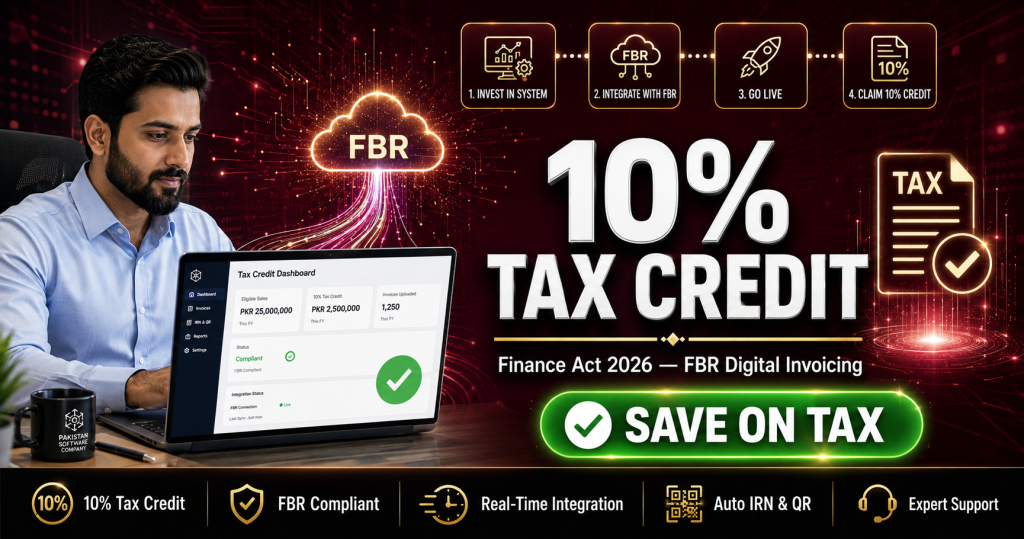
The Finance Act, 2026 — effective from 1 July 2026 — has changed the economics of FBR digital invoicing. For the first time, the government will give you back 10% of what you invest in integrating your POS, ERP, or invoicing system with FBR. At the same time, it has handed FBR tough new powers to suspend or blacklist businesses that don’t comply. Here is exactly what changed, who qualifies for the tax credit, and what you should do now.
Key Takeaways
- New Section 64D of the Income Tax Ordinance gives a 10% tax credit on eligible investment in FBR integration hardware and software.
- The credit applies only in the tax year the system is installed, integrated, and fully configured with FBR.
- Ongoing maintenance and recurring costs do not qualify — only the initial setup investment does.
- The Commissioner can now suspend registration or blacklist businesses that fail to comply with electronic invoicing rules.
- Combined with existing penalties of Rs 500,000 to Rs 3,000,000, the message is clear: integrate now — and get rewarded for it.
What did the Finance Act 2026 change for digital invoicing?
The Finance Bill 2026 was presented on 12 June 2026 as part of the Federal Budget 2026–27 and became law on 1 July 2026. It amends the Income Tax Ordinance 2001, the Sales Tax Act 1990, and the Federal Excise Act 2005 — with a heavy focus on documentation of the economy and digital tax administration.
For businesses dealing with FBR digital invoicing, three changes matter most:
- A 10% tax credit on investment in integration technology (new Section 64D).
- Suspension and blacklisting powers for non-compliance with electronic invoicing and production monitoring.
- New invoice rules — including invoices for exempt supplies, advance receipt invoices, and mandatory verifiable unique FBR invoice numbers from a date FBR will notify.
In short: the stick got bigger, but for the first time there is also a real carrot.
What is the Section 64D tax credit?
Section 64D is a new provision inserted into the Income Tax Ordinance, 2001. It grants a tax credit equal to 10% of the amount invested in eligible electronic resources to any person required — under the Income Tax Ordinance, the Sales Tax Act, or the Federal Excise Act — to integrate with FBR’s computerised system for real-time production monitoring or electronic recording and reporting of sales and receipts.
In plain language: if the law requires you to connect your billing system to FBR, the technology you buy to do it now earns you a tax credit.
What expenses qualify?
The credit covers expenditure incurred exclusively on the purchase, acquisition, installation, and implementation of:
- Equipment and hardware (e.g. POS terminals, printers, servers used for integration)
- Software directly used to integrate with FBR’s digital platform
- Other electronic components required for the integration
What does NOT qualify?
- Operational and maintenance expenses after installation
- Recurring costs (subscriptions, support fees, and similar ongoing charges)
- Investment in years other than the tax year in which the system is installed, integrated, and fully configured with FBR
How is the credit adjusted?
The tax credit is adjustable only against your normal tax liability under Division I or Division II of Part I of the First Schedule to the Income Tax Ordinance. FBR has also been empowered to prescribe further conditions, limitations, and restrictions, so expect an SRO or circular spelling out the claim procedure. Confirm the details with your tax advisor before filing.
How much can a business actually save?
Here is a simple illustration of how the 10% credit works on typical integration spending (figures are examples only — your actual costs and tax position will differ):
| Business type | Example integration investment | Potential 10% tax credit |
|---|---|---|
| Small retail shop (1 POS) | Rs 150,000 | Rs 15,000 |
| Restaurant (3 POS stations) | Rs 500,000 | Rs 50,000 |
| Multi-branch retailer / distributor | Rs 1,500,000 | Rs 150,000 |
| Manufacturer with ERP + monitoring hardware | Rs 5,000,000 | Rs 500,000 |
Compare that with the cost of not integrating: penalties under the Sales Tax Act start around Rs 500,000 and can rise to Rs 3,000,000 for repeated violations — plus your invoices become legally invalid. We covered the full penalty picture in our guide on the FBR digital invoicing July 2026 deadline and penalties.
What are the new suspension and blacklisting powers?
The Finance Act expands Section 21 of the Sales Tax Act 1990. The Commissioner can now suspend the registration of, or blacklist, registered persons involved in non-compliance with electronic invoicing or production monitoring provisions, following procedures FBR will prescribe.
For a business, suspension or blacklisting is far more damaging than a fine:
- Your customers may lose their input tax adjustment on purchases from you.
- Compliant businesses will avoid dealing with a blacklisted supplier.
- Getting removed from a blacklist is a slow, painful process.
Other invoice changes you should know
- Invoices for exempt supplies: invoicing requirements now extend to exempt supplies as well.
- Advance receipt invoices: FBR can notify persons or classes of persons allowed to issue an advance receipt invoice within the notified system.
- Verifiable unique FBR invoice numbers: generation of verifiable, unique FBR invoice numbers becomes mandatory from a date FBR will notify.
- Compliance-linked benefits: FBR can prescribe lower sales tax rates and adjust input tax limits for digitally integrated, compliant businesses — compliance is being rewarded across the system, not just through Section 64D.
These build on the framework already in motion — including the draft SRO 288(I)/2026 rules on online integration of businesses, which pull many service businesses into the net for the first time.
How to claim the benefit: 5 steps
- Confirm you are required to integrateCheck whether your business falls under mandatory integration — under the Sales Tax rules, the Federal Excise framework, or the income-tax online integration rules. The credit is for persons required to integrate.
- Plan your integration investmentChoose an integration-ready POS or ERP and list the hardware, software, and implementation costs. Only the initial setup spend qualifies — structure your purchase accordingly.
- Complete integration and full configurationRegister on the FBR portal, integrate through the proper licensed channel, run sandbox testing, and go live. The credit applies in the tax year the system is installed, integrated, and fully configured.
- Document everythingKeep invoices and proof of payment for every eligible component — equipment, hardware, software, installation, and implementation — separated from recurring or maintenance charges.
- Claim the credit in your returnWork with your tax advisor to adjust the 10% credit against your normal tax liability, and watch for FBR’s notification prescribing the conditions and procedure.
What should you do now?
If you have been delaying FBR digital invoicing because of cost, the Finance Act 2026 has removed that excuse — the government is effectively refunding 10% of your setup investment through the tax system. And if you delay further, the risk is no longer just a fine: it is suspension or blacklisting.
The smart move is to integrate within this tax year, capture the credit, and put compliance behind you.
Integrate with FBR — and claim your 10% credit
Switcher Techno provides FBR digital invoicing integration services across Pakistan — from an integration-ready POS or ERP to registration, sandbox testing, and go-live. We help you get compliant smoothly, with documentation you can use for your Section 64D claim.
Book a Free DemoFrequently Asked Questions
What is the Section 64D tax credit in the Finance Act 2026?
It is a new tax credit equal to 10% of the amount invested in eligible electronic resources — equipment, hardware, and software — used to integrate a business with FBR’s computerised system for real-time monitoring and electronic reporting of sales and receipts.
Who is eligible for the 10% FBR integration tax credit?
Any person required under the Income Tax Ordinance 2001, the Sales Tax Act 1990, or the Federal Excise Act 2005 to integrate with FBR’s computerised system for real-time production monitoring or electronic recording and reporting of sales and receipts.
Does the credit cover monthly software fees and maintenance?
No. Operational, maintenance, and recurring expenses incurred after installation do not qualify. Only the initial purchase, acquisition, installation, and implementation of the integration technology is eligible.
When can the credit be claimed?
Only in the tax year in which the electronic resources are installed, integrated, and fully configured with FBR’s computerised system. It is adjustable against normal tax liability, subject to conditions FBR prescribes.
What happens if a business still doesn’t integrate?
Alongside existing monetary penalties of Rs 500,000 up to Rs 3,000,000 under the Sales Tax Act, the Finance Act 2026 empowers the Commissioner to suspend the registration of, or blacklist, businesses that fail to comply with electronic invoicing or production monitoring requirements.
Disclaimer: This article is for informational purposes only and should not be considered legal or tax advice. Figures shown are illustrative. Always confirm your eligibility, deadlines, and claim procedure with the official FBR portal and a qualified tax advisor.
