
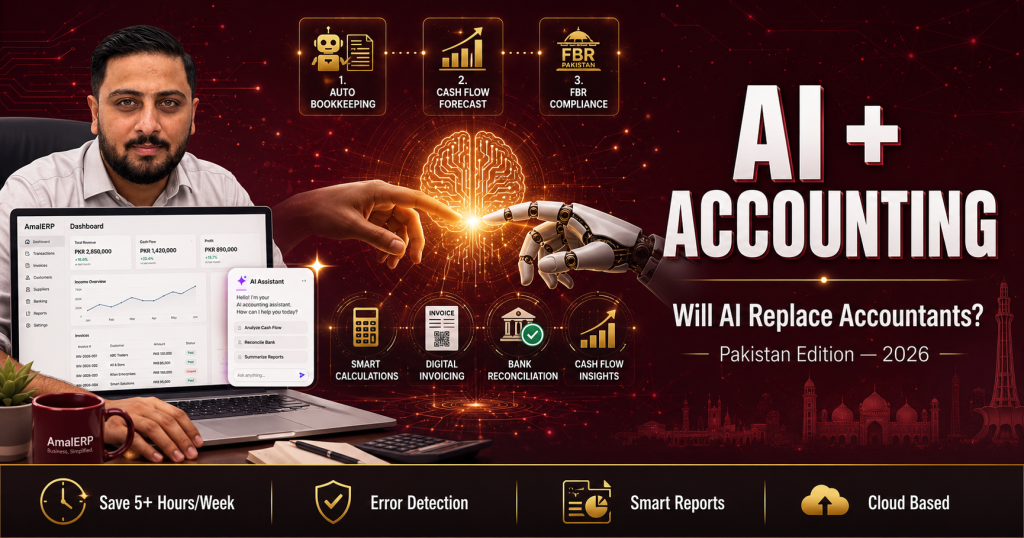
AI has moved from buzzword to bookkeeping. The global AI accounting market has grown to an estimated $10.87 billion in 2026, and adoption of AI-driven financial tools among small and mid-sized businesses has jumped from 37% in 2023 to 85% today. So what does this mean for a business in Pakistan — and for your accountant? Here is a clear look at what AI actually does in accounting software, what it cannot do, and how Pakistani businesses can use it to save hours every week while staying FBR-compliant.
Key Takeaways
- AI in accounting software automates data entry, transaction categorization, bank reconciliation, and reporting — the tasks that consume most of a bookkeeper’s day.
- Businesses using AI-powered accounting tools report saving 5+ hours per week on routine financial work.
- AI will not replace accountants — surveys show firms prefer upskilling staff (40%) over replacing roles with AI (21%). AI changes what accountants do, not whether they’re needed.
- For Pakistani businesses, the biggest wins are error-free FBR compliance, real-time cash flow visibility, and escaping manual registers and Excel.
- The right first step is moving to a modern cloud accounting and inventory software that has AI capabilities built in — not bolting AI onto broken manual processes.
What is AI accounting software?
AI accounting software is accounting software that uses artificial intelligence and machine learning to do work that previously required manual effort — reading invoices, categorizing transactions, matching bank entries, spotting unusual activity, and answering financial questions in plain language.
Traditional accounting software was a smart calculator: it stored what you typed and produced reports. AI accounting software is closer to a junior accountant: it learns your patterns, does the repetitive work itself, and flags what needs a human decision. The industry is now moving a step further into “agentic AI” — systems that don’t just answer questions but take action: detecting a vendor invoice, matching it to a purchase order, coding it to the right ledger account, and scheduling the payment.
What can AI actually do in accounting? 6 real capabilities
1. Automated data entry and categorization
AI reads invoices, receipts, and bank feeds, then records and categorizes transactions automatically. It learns from corrections — the more you use it, the more accurate it gets. This alone eliminates the biggest time sink in bookkeeping.
2. Bank reconciliation in minutes, not hours
Machine learning matches bank transactions against your books using patterns from your history. What used to take an afternoon at month-end becomes a review of a handful of exceptions.
3. Cash flow forecasting
AI models analyze your historical data — payment cycles, seasonality, customer behavior — to predict future cash positions. Imagine knowing in advance that a cash crunch is likely in a slow month because receivables historically slow down. That foresight lets you arrange financing proactively instead of scrambling to cover salaries.
4. Error and fraud detection
AI excels at pattern recognition, so it catches what humans miss: a duplicate payment, a supplier invoice 30% above the usual rate, an expense that doesn’t fit the pattern. For SMBs that lack the internal controls of large companies, this automated watchdog is a serious layer of protection.
5. Plain-language financial answers
Modern interfaces let you ask questions the way you’d ask an accountant — “What was my profit last month?” or “Which product is giving the best margin?” — and get direct, data-backed answers. Financial insight stops being locked behind report menus.
6. Smart compliance support
AI-assisted validation checks invoices for errors before they’re submitted — wrong tax rates, missing fields, mismatched totals. In Pakistan’s context, where FBR digital invoicing demands real-time, error-free invoice reporting, this pre-submission checking matters more than ever.
So — will AI replace accountants?
Short answer: no. The evidence points the other way.
In a 2026 survey of businesses using accounting software, replacing roles with AI automation was mentioned by only 21% of respondents — while the top strategy, at 40%, was upskilling existing employees. Industry leaders across major accounting platforms describe the same shift: AI takes over the “non-negotiables” — the invoices that must be entered, the books that must be reconciled — and moves the accountant’s role from data entry to review, judgment, and advisory.
Think of it this way: AI is excellent at pattern recognition and continuous monitoring. Humans provide context, judgment, and strategy. A machine can flag that a supplier’s rate jumped 30%; it takes a person to know whether that’s fraud, inflation, or a renegotiated contract. AI changes what accountants do — not whether businesses need them.
Pakistani vendors are starting to ship this rather than promise it. AmalERP, built by the Switcher Techno team, folds an AI layer into its cloud ERP so an owner can ask plain questions about their own books instead of exporting to a spreadsheet first.
What does this mean for Pakistani businesses?
Globally, AI accounting is about efficiency. In Pakistan, the stakes are higher, because most SMBs are starting from further back:
- Most businesses still run on registers and Excel. Manual books mean no real-time picture of profit, stock, or receivables — and Excel can’t reconcile itself, forecast cash flow, or catch a duplicate payment. Before AI can help you, your data needs to live in a proper accounting and inventory system instead of scattered files.
- FBR compliance is now digital and real-time. With mandatory e-invoicing, the 72-hour invoice correction limit, and enforcement actions like green channel removal for importers, there is no room for manual invoice errors. AI-assisted validation catches mistakes before they reach FBR.
- Skilled accountants are expensive and scarce. A small trader in Karachi or Lahore can’t hire a full finance team — but AI-powered software gives them automated books, smart alerts, and instant reports at a fraction of one salary.
- There’s now a tax incentive to modernize. Under the Finance Act 2026, businesses required to integrate with FBR can claim a 10% tax credit on their integration technology investment — hardware and software included. The government is effectively subsidizing your upgrade.
Manual bookkeeping vs AI-powered accounting
| Task | Manual / Excel | AI-powered accounting software |
|---|---|---|
| Recording transactions | Typed by hand, error-prone | Auto-captured and categorized |
| Bank reconciliation | Hours at month-end | Auto-matched; only exceptions reviewed |
| Cash flow visibility | Known after the crisis | Forecast weeks in advance |
| Error & fraud detection | Found at audit — if ever | Flagged in real time |
| FBR invoice compliance | Manual, mistake-prone | Validated before submission |
| Reports | Built manually in Excel | One click, always current |
How to choose AI-ready accounting software in Pakistan: 5 things to check
- Cloud-based, not desktop-lockedAI features need live data. Choose cloud accounting software you can access from shop, office, and mobile — with automatic backups instead of a computer that can crash with your books on it.
- Accounting + inventory togetherFor trading and retail businesses, profit hides in stock. Software that combines accounting and inventory management gives AI the complete picture — sales, purchases, stock, and cash in one system.
- FBR digital invoicing supportAny software you buy in 2026 must handle FBR e-invoicing — real-time invoice reporting with QR codes through the licensed integrator process. Buying software without this is buying a problem.
- Practical AI features, not slogansAsk specifically: does it auto-categorize transactions? Flag anomalies? Generate reports and insights automatically? Support smart reminders for receivables? A demo shows more than a brochure.
- Local support and trainingAI reduces work but your team still needs onboarding. Choose a provider with Pakistan-based support that understands local business practices, sales tax, and FBR requirements — not a foreign tool with email-only help.
The bottom line
AI in accounting is not a future trend — it’s the current standard, growing at over 44% a year globally. For Pakistani businesses, it arrives at the perfect moment: FBR has made digital record-keeping mandatory, and the Finance Act 2026 is rewarding those who invest in it. The businesses that move their books from registers and Excel into AI-powered cloud software will run faster, catch errors earlier, and stay compliant automatically. The ones that don’t will keep paying for those advantages the hard way — in hours, errors, and penalties.
Bring AI to Your Books — Without the Complexity
Switcher Techno’s cloud accounting and inventory software gives Pakistani businesses automated bookkeeping, real-time reports, smart business insights, and FBR digital invoicing support — with local training and support. See it live on your own business data.
Book a Free DemoFrequently Asked Questions
What is AI accounting software?
It is accounting software that uses artificial intelligence to automate manual work — reading and categorizing transactions, reconciling bank entries, forecasting cash flow, detecting errors and fraud, and answering financial questions in plain language.
Will AI replace accountants in Pakistan?
No. AI automates repetitive data work, but human accountants remain essential for judgment, tax strategy, and decision-making. Surveys show businesses prefer upskilling staff to work with AI (40%) over replacing roles with it (21%). The role shifts from data entry to review and advisory.
How much time can AI accounting software save?
Businesses using AI-powered accounting tools commonly report saving five or more hours per week on routine tasks like data entry, categorization, and reconciliation — time that goes back into running the business.
Is AI accounting software suitable for small businesses in Pakistan?
Yes — arguably it benefits small businesses most, because they can’t afford large finance teams. Cloud-based accounting and inventory software with AI features gives an SMB automated books, real-time reports, and compliance support at a fraction of the cost of manual processes.
Does AI accounting software help with FBR compliance?
Yes. AI-assisted validation checks invoices for errors before submission, which matters under FBR’s real-time digital invoicing regime where invoices can only be corrected within 72 hours. Modern software also supports e-invoice generation through the licensed integrator process.
Is there any government incentive for adopting digital accounting systems?
Yes. Under Section 64D introduced by the Finance Act 2026, businesses required to integrate with FBR’s system can claim a 10% tax credit on eligible investment in integration hardware and software, in the tax year the system is installed and fully configured.
Disclaimer: This article is for informational purposes only. Market statistics are based on published industry research and may evolve. Always confirm tax and compliance details with the official FBR portal and a qualified advisor.
