
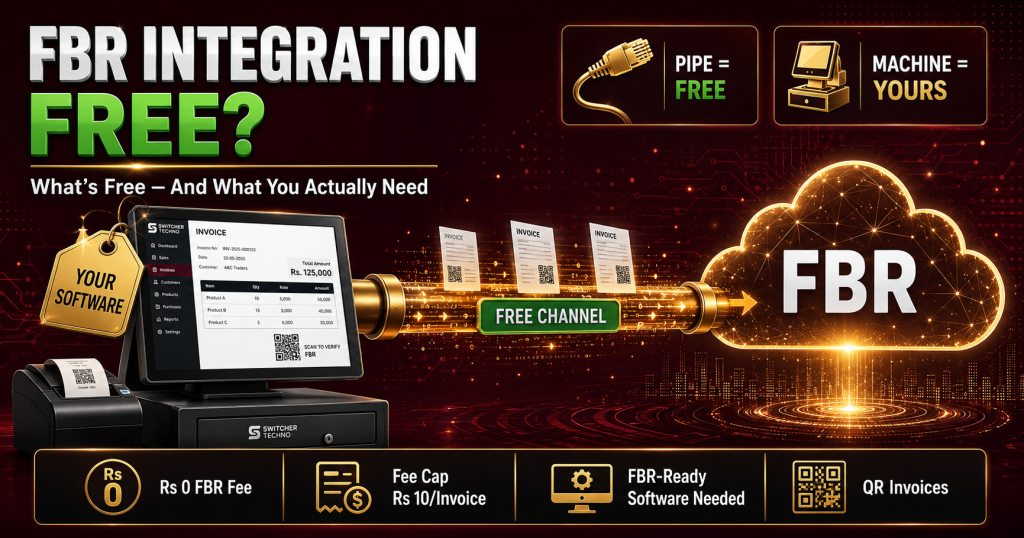
“FBR integration is free through PRAL” — you’ve probably heard this, and it’s partly true. There is no fee payable to FBR for digital invoicing integration, and PRAL offers a free integration channel. But here’s what that sentence leaves out: the free part is only the connection to FBR. Before anything can be connected, your business needs an integration-ready invoicing system that can actually produce FBR-compliant digital invoices. This guide explains exactly what’s free, what isn’t, and what you actually need to become compliant.
Key Takeaways
- FBR charges nothing for digital invoicing integration — and integration through PRAL is offered free of cost.
- For licensed integrators, the government has capped configuration fees at Rs 10 per invoice or Rs 1 million maximum.
- The free part is the channel to FBR — not the invoicing system. FBR provides no downloadable billing software.
- What you actually need: an FBR-ready POS or ERP that generates structured invoices with correct HS codes, tax rates, QR codes, and offline handling — plus configuration, training, and support.
- “Free” without the right software is like a free SIM card without a phone — the channel exists, but nothing can travel through it.
What does “free integration through PRAL” actually mean?
Under Pakistan’s digital invoicing framework, a registered business must integrate its invoicing system with FBR’s computerized system through a licensed integrator or PRAL (Pakistan Revenue Automation Limited — FBR’s own technology organization). Two cost facts are confirmed by FBR itself:
- A registered person does not pay any fee to FBR for the electronic invoicing system.
- Where a licensed integrator charges for configuration and integration, the fee is capped by the Board — set at Rs 10 per invoice or Rs 1 million in total.
So yes — the integration channel is free (PRAL) or price-capped (licensed integrators). No physical visit is required either; the process is technical and happens between your software and FBR’s system, with sandbox testing before go-live.
Here’s the part most people miss: FBR provides no downloadable invoicing software. That’s stated in FBR’s own FAQs. The integration channel connects your system to FBR — which means you must have a system worth connecting.
The pipe vs the machine: a simple analogy
Think of digital invoicing as two parts:
- The pipe — the connection that carries your invoices to FBR in real time and brings back a unique FBR invoice number and QR code. This is what PRAL/licensed integrators provide. This part is free or capped.
- The machine — the POS, ERP, or invoicing software that actually creates each invoice: the right format, the right fields, the right tax treatment. This part is your responsibility, and it’s where compliance is won or lost.
A free pipe with no machine produces nothing. And a machine that produces malformed invoices will fail at the pipe — rejected submissions, wrong tax reporting, and errors you must fix within the 72-hour invoice correction window or face Commissioner approval for every change.
What your invoicing system must actually do
For an invoice to be accepted by FBR’s system, your software has to handle real technical requirements — every sale, in real time:
- Structured invoice format — not a scanned bill or PDF; a properly structured electronic invoice with all mandatory fields
- Correct HS codes and sale types — FBR’s own guidance shows how items with the same HS code but different tax treatment (e.g. standard rate vs 3rd Schedule goods) must be reported separately; clubbing them causes incorrect tax treatment
- Unique FBR invoice number + QR code — obtained in real time and printed on the customer’s receipt
- Invoice timing rules — digital invoices must be issued at the time of supply (payment or delivery, whichever is earlier)
- Offline resilience — internet failures happen; your system must keep billing and sync with FBR when the connection returns, following the rules for such eventualities
- Corrections, returns, and credit/debit notes — handled through the proper FBR mechanism, with an audit trail
The real cost breakdown: free vs paid
| Component | Cost | Who provides it |
|---|---|---|
| Fee to FBR | Rs 0 — FBR charges nothing | — |
| Integration channel via PRAL | Free of cost | PRAL (FBR’s technology arm) |
| Licensed integrator configuration | Capped at Rs 10/invoice or Rs 1 million max | Licensed integrator |
| FBR-ready POS / ERP software | Your investment — varies by business size | Software provider (e.g. Switcher Techno) |
| Hardware (POS terminals, printers) | Your investment, if needed | Hardware vendor |
| Setup, training & ongoing support | Depends on provider | Software provider |
How the full process works: 5 steps
- Confirm your category and deadlineCheck whether your business falls under mandatory digital invoicing and identify your phase. If you’re unsure where you stand, start with our complete FBR digital invoicing guide.
- Get an FBR-ready invoicing system firstThis is the step people skip — and the reason “free integration” stalls. Your POS or ERP must produce structured, compliant invoices before there’s anything to integrate. Choose software built for FBR requirements: HS codes, sale types, QR printing, offline mode, and returns handling.
- Register on the FBR portalComplete digital invoicing registration through IRIS for your business, outlets, and POS stations. No physical visit is needed at any stage.
- Integrate through PRAL or a licensed integratorYour software connects to FBR through the licensed channel — sandbox testing first, then production. Since STGO 01 of 2026, a business may even engage more than one licensed integrator.
- Go live and stay compliantEvery sale now returns a unique FBR invoice number and QR code in real time. Train your billing staff — remember, errors can only be corrected within 72 hours without approval.
So should you use the free PRAL route?
If your invoicing software is already FBR-ready, the free channel is a genuine saving — use it. The question that actually determines your compliance, cost, and daily operations isn’t “which channel is free?” — it’s “is my billing system capable of FBR digital invoicing at all?”
For most SMBs still running on Excel, manual registers, or legacy software, the honest answer is no. The right sequence is: get the machine right, then connect it through whichever licensed channel suits you. Trying to do it in reverse — chasing the free pipe with no compliant system behind it — is how businesses end up registered, “integrated” on paper, and still facing notices.
Get FBR-Ready Software + Complete Integration Support
Switcher Techno provides FBR digital invoicing integration services across Pakistan — an integration-ready POS or ERP that generates compliant QR invoices, registration on the FBR portal, integration through the proper licensed channel, sandbox testing, staff training, and go-live. One team, end to end.
Book a Free DemoFrequently Asked Questions
Is FBR digital invoicing integration really free?
Partly. FBR itself charges no fee, and PRAL offers a free integration channel. But the free part covers only the connection to FBR — you still need an FBR-ready POS or ERP that can produce compliant electronic invoices, which is a separate investment.
What is PRAL?
Pakistan Revenue Automation Limited (PRAL) is FBR’s technology organization. It is one of the channels through which registered businesses can integrate their invoicing systems with FBR’s computerized system, offered free of cost.
How much can a licensed integrator charge?
The government has capped licensed integrator configuration and integration fees at Rs 10 per invoice or Rs 1 million in total, as specified through a sales tax general order.
Does FBR provide invoicing software?
No. Per FBR’s own FAQs, there is no downloadable software from FBR. Businesses must have their own POS, ERP, or invoicing system, which is then integrated with FBR through PRAL or a licensed integrator.
Can I use more than one licensed integrator?
Yes. Under STGO No. 01 of 2026, a registered person may engage one or more licensed integrators as approved or notified by FBR.
What happens if my software isn’t FBR-compliant?
Invoices issued outside the FBR system are legally invalid, and non-compliance carries penalties from around Rs 500,000 up to Rs 3,000,000 — along with enforcement actions such as registration suspension. Getting a compliant system first is the foundation of everything else.
Disclaimer: This article is for informational purposes only and should not be considered legal or tax advice. Fee caps, procedures, and requirements can change — always confirm current details with the official FBR portal and a qualified tax advisor.
