
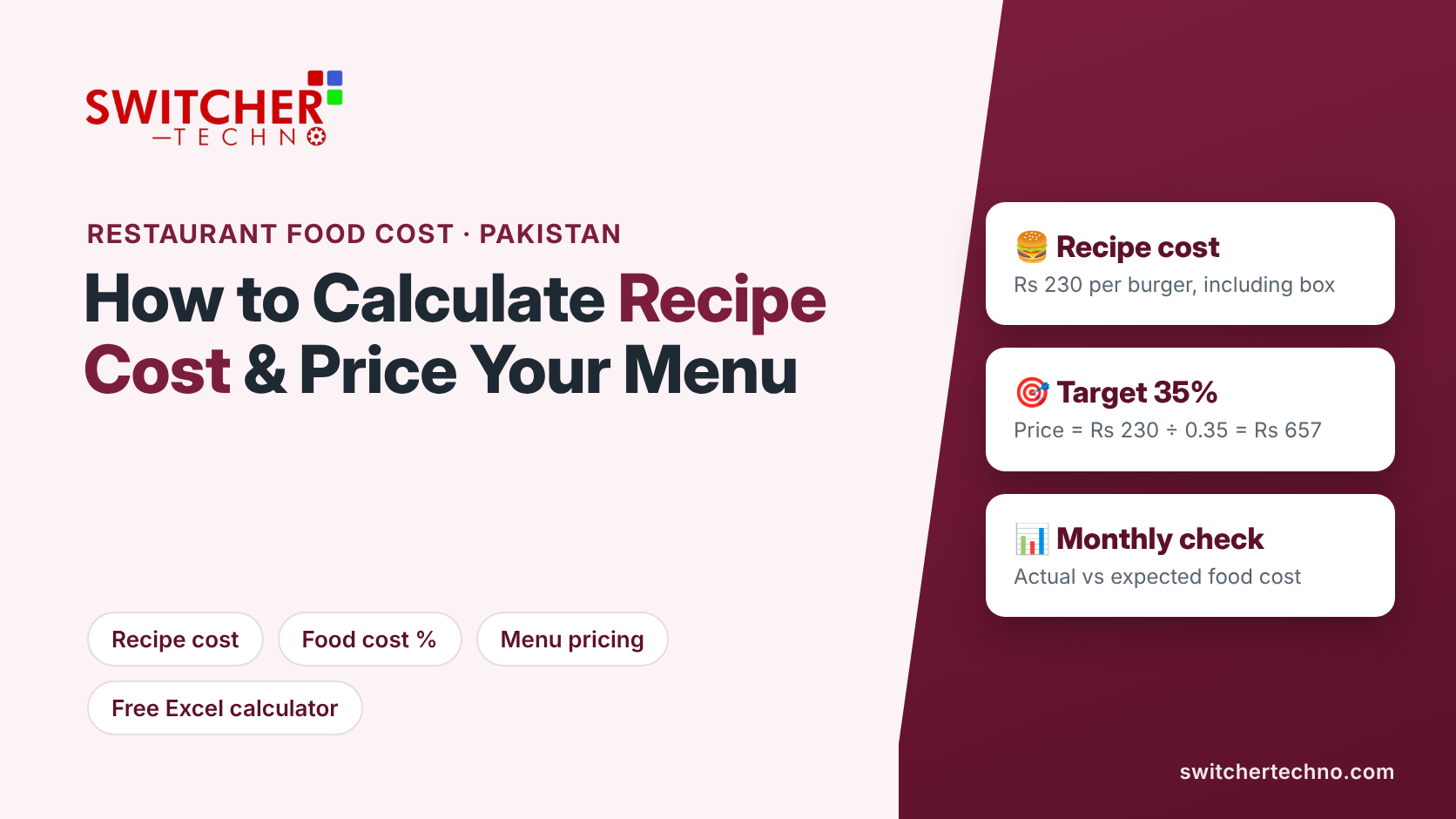
Restaurant Food Cost in Pakistan: How to Calculate Recipe Cost and Price Your Menu (Free Excel Calculator)
In short: Food cost percentage is the cost of the ingredients in a dish divided by its selling price before tax. Work out the recipe cost of every dish, including trimming loss and packaging, then set the menu price by dividing that cost by your target food cost percentage. Many restaurants aim for roughly 28% to 35%. Each month, check your actual food cost from stock and purchases; if it is well above your recipe cost, you are losing money to waste, over-portioning or theft.
Chicken, oil and vegetable prices in Pakistan can change from one week to the next. A burger that made a healthy profit in January can be close to break-even by June if nobody updated the recipe cost. Most restaurant owners know their sales to the rupee but only guess their food cost, and that guess is usually too low.
This guide shows how to calculate the cost of each dish, set menu prices that protect your margin, and check every month whether the kitchen is actually achieving it. You can download the free recipe cost and menu price calculator (Excel) and follow along.
The three numbers every restaurant owner should know
| Number | Formula | What it tells you |
|---|---|---|
| Recipe cost | Sum of (quantity used × real cost per unit) for every ingredient, plus packaging | What one plate costs you to make |
| Food cost % of a dish | Recipe cost ÷ menu price before tax × 100 | Whether that dish is priced correctly |
| Actual food cost % for the month | (Opening stock + purchases − closing stock) ÷ food sales × 100 | Whether the kitchen matches the recipes |
Step 1: Find the real cost per unit of each ingredient
The price on the supplier’s bill is not always the cost of what reaches the plate. If you buy 1 kg of chicken and only 850 g is usable after trimming, your yield is 85%, and the real cost is higher than the bill price:
Real cost per kg = purchase price per kg ÷ yield %
At Rs 1,000 per kg and 85% yield, the real cost is Rs 1,000 ÷ 0.85 = about Rs 1,176 per usable kg. Ignore yield and every chicken dish on your menu looks cheaper than it really is.
Step 2: Cost the recipe, plate by plate
Here is a worked example for a crispy chicken burger. The prices are examples only; use your own purchase prices.
| Ingredient | Quantity per burger | Real cost per unit | Cost |
|---|---|---|---|
| Boneless chicken | 130 g | Rs 1,000 per kg | Rs 130 |
| Bun | 1 | Rs 35 each | Rs 35 |
| Coating and spices | 1 portion | Rs 15 | Rs 15 |
| Frying oil absorbed | 1 portion | Rs 15 | Rs 15 |
| Sauce and lettuce | 1 portion | Rs 15 | Rs 15 |
| Box and wrapper | 1 | Rs 20 | Rs 20 |
| Recipe cost | Rs 230 | ||
Include packaging in the recipe cost for takeaway and delivery items. For dine-in only dishes, leave it out.
Step 3: Set the menu price from your target food cost
Menu price before tax = recipe cost ÷ target food cost %
With a recipe cost of Rs 230 and a target of 35%, the price is Rs 230 ÷ 0.35 = Rs 657. You might round it to Rs 650 or Rs 690 depending on your market. At Rs 650, food cost is 35.4%; at Rs 690, it is 33.3%.
Provincial sales tax on restaurant services (SRB, PRA, KPRA, BRA or ICT) is added on top of this price on the bill, so do not count it as revenue. Make it clear on your menu whether prices include tax. In Punjab, for example, bills are now taxed at 8% when paid by card and 16% in cash; see our guide to the new Punjab restaurant tax rate.
Food cost is the starting point, not the whole story. Check what nearby restaurants charge, what your customers will pay and how much the dish sells. A popular dish at 38% food cost can earn more in total than a slow seller at 25%.
Step 4: Check your actual food cost every month
Recipe costs tell you what food cost should be. Stock and purchases tell you what it was.
| Item | Amount |
|---|---|
| Opening food stock (1st of the month) | Rs 400,000 |
| + Food purchases during the month | Rs 1,800,000 |
| − Closing food stock (last day of the month) | Rs 450,000 |
| = Cost of food used | Rs 1,750,000 |
| Food sales before tax | Rs 5,200,000 |
| Actual food cost % | 33.7% |
Now compare this with your expected food cost: the recipe cost of every dish sold, added up, divided by food sales. If the recipes say 30% and the stock says 33.7%, roughly Rs 190,000 this month disappeared between the store and the plate.
Why actual food cost is higher than recipe cost
- Over-portioning. An extra 20 g of chicken on every plate adds up fast. Use scales and portion cups.
- Waste and spoilage. Food prepared and not sold, items that expire, burnt orders. Record waste daily.
- Staff meals not recorded. Staff food is a real cost; enter it so it does not hide inside “food cost”.
- Old recipe costs. If chicken or oil prices went up and the recipes still use old prices, the recipe cost is wrong, not the kitchen.
- Theft and missing bills. Orders served without a bill or stock leaving the back door. Matching stock to sales is the only way to see it.
- Delivery app orders and your restaurant POS
Five food cost mistakes Pakistani restaurants make
- Pricing only by copying competitors. Their costs, rent and portions are not yours.
- Not updating costs when prices move. Review recipe costs whenever a key ingredient changes price, and at least once a month.
- Forgetting packaging and delivery costs. Boxes, bags, sauces and any delivery platform commission all reduce what a delivery order really earns.
- Counting sales tax as income. The tax on the bill belongs to SRB, PRA or the relevant authority, not to the restaurant.
- Checking food cost once a year. By then the losses are history. Count key stock weekly and do a full count monthly.
How restaurant software does this for you
Doing this in a notebook or Excel works for a small menu, but it breaks down when you have 80 dishes and prices change every week. A restaurant POS with recipe costing stores a recipe for every dish, deducts the ingredients from stock on every sale, updates recipe costs from your latest purchase prices and shows expected versus actual stock, so you can see where the gap is.
Switcher Techno’s restaurant POS includes recipe and bill of materials, ingredient inventory, vendor purchases and sales reports by item, and connects to our accounting software for your monthly accounts.
Food cost that stays too high can also point to leakage at the counter or in the store. See our guide on how to stop waiter and cash theft.
Know the real cost of every dish
Book a free demo with your own menu and recipes, and see your food cost per dish before you change a single price. Local support from Karachi and Lahore.
Frequently asked questions
What is a good food cost percentage for a restaurant in Pakistan?
There is no official benchmark, but many restaurants aim for roughly 28% to 35% of the menu price before tax. Cafes and fast food can run lower, while meat-heavy dishes such as BBQ and karahi often run higher.
How do I calculate food cost percentage?
Divide the cost of ingredients by the selling price before tax and multiply by 100. For a whole month, use opening stock plus purchases minus closing stock, divided by food sales.
How do I calculate the recipe cost of a dish?
List every ingredient with the quantity used per plate, multiply each by its real cost per unit after trimming loss, and add packaging for takeaway and delivery items.
How do I set a menu price from food cost?
Divide the recipe cost by your target food cost percentage. A Rs 230 recipe at a 35% target gives a price of about Rs 657 before tax.
How often should I update recipe costs?
Update them whenever a key ingredient such as chicken, mutton or oil changes price, and review all recipes at least once a month.
Why is my actual food cost higher than my recipe cost?
The usual causes are over-portioning, waste, unrecorded staff meals, out-of-date recipe costs and stock leaving without a bill. Comparing expected and actual stock shows where the gap is.
Prices in this article are examples to show the method, not market rates. Food cost targets vary by cuisine, location and concept. This is general business guidance, not accounting or tax advice.
