
Bank Reconciliation in Pakistan: A Step-by-Step Guide for Small Businesses (Free Excel Template)
In short: A bank reconciliation matches the bank balance in your books with the balance on your bank statement and explains every difference. In Pakistan, the usual differences are cheques not yet cleared, online transfers (IBFT or Raast) your team has not recorded, bank charges, tax the bank has deducted, profit credited to a savings account and bounced cheques. Do it at least once a month for every bank account, fix your books for the items only the bank knows about, and keep the signed reconciliation on file.
Ask most small business owners in Karachi or Lahore what is in the bank and they will open the banking app, not the books. The two numbers rarely match, and nobody is quite sure why. Somewhere in the gap there might be a bounced cheque from a customer, a supplier payment entered twice, or bank charges that have been quietly piling up for months.
A monthly bank reconciliation closes that gap. This guide explains what to check, walks through a worked example, and gives you a free bank reconciliation template in Excel that does the arithmetic for you.
What is a bank reconciliation?
It is a short statement, usually prepared at month end, that starts with two numbers: the balance on the bank statement and the balance of the same bank account in your books (your cash book or bank ledger). It then lists every item that explains why they are different. When the adjusted bank balance and the adjusted book balance are equal, the account is reconciled.
Why the two balances are different
| Item | Recorded in your books? | Shown by the bank? | What to do |
|---|---|---|---|
| Cheques you issued that have not been presented yet | Yes | Not yet | List as unpresented cheques; no entry needed |
| Cheques or cash you deposited that have not cleared yet | Yes | Not yet | List as deposits in transit; no entry needed |
| Online transfers from customers (IBFT, Raast) not yet entered | No | Yes | Record the receipt against the right customer |
| Bank charges, SMS alerts, card and cheque book fees | No | Yes | Record as bank charges |
| Tax deducted by the bank | No | Yes | Record in an advance tax account, not as an expense |
| Profit credited on a savings or PLS account | No | Yes | Record as other income |
| Customer cheque returned unpaid (bounced) | No (still shown as received) | Yes | Reverse the receipt and put the amount back on the customer’s account |
| Errors, such as an amount typed wrong or a payment entered twice | Wrong | Correct | Correct the entry in your books |
Customers often pay by IBFT or Raast with no invoice number in the reference. If nobody records these deposits, the customer still looks overdue and your sales team chases money that has already arrived. Ask customers to quote the invoice number, and clear unidentified deposits every week, not at month end.
How to do a bank reconciliation, step by step
- Get the statement and close the books. Download the bank statement for the month and make sure every receipt and payment for the month has been entered in your cash book or bank ledger.
- Tick off matching items. Go through the statement line by line and tick each item that also appears in your books with the same amount. Cheque numbers make this much faster.
- List the unticked items in your books. These are usually cheques not yet presented and deposits not yet cleared. They are timing differences and need no correction.
- List the unticked items on the statement. These are things only the bank knows about: charges, tax deducted, profit, online receipts and bounced cheques.
- Update your books. Record the bank-only items from step 4 in your accounts, so your book balance becomes correct.
- Prepare the reconciliation statement. Adjust the bank balance for timing differences and the book balance for the items you just recorded. The two adjusted figures must be equal.
- Investigate, sign and file. If they do not match, look for errors and missing entries. Once they agree, have the preparer and a second person sign it, and keep it with the bank statement.
Worked example
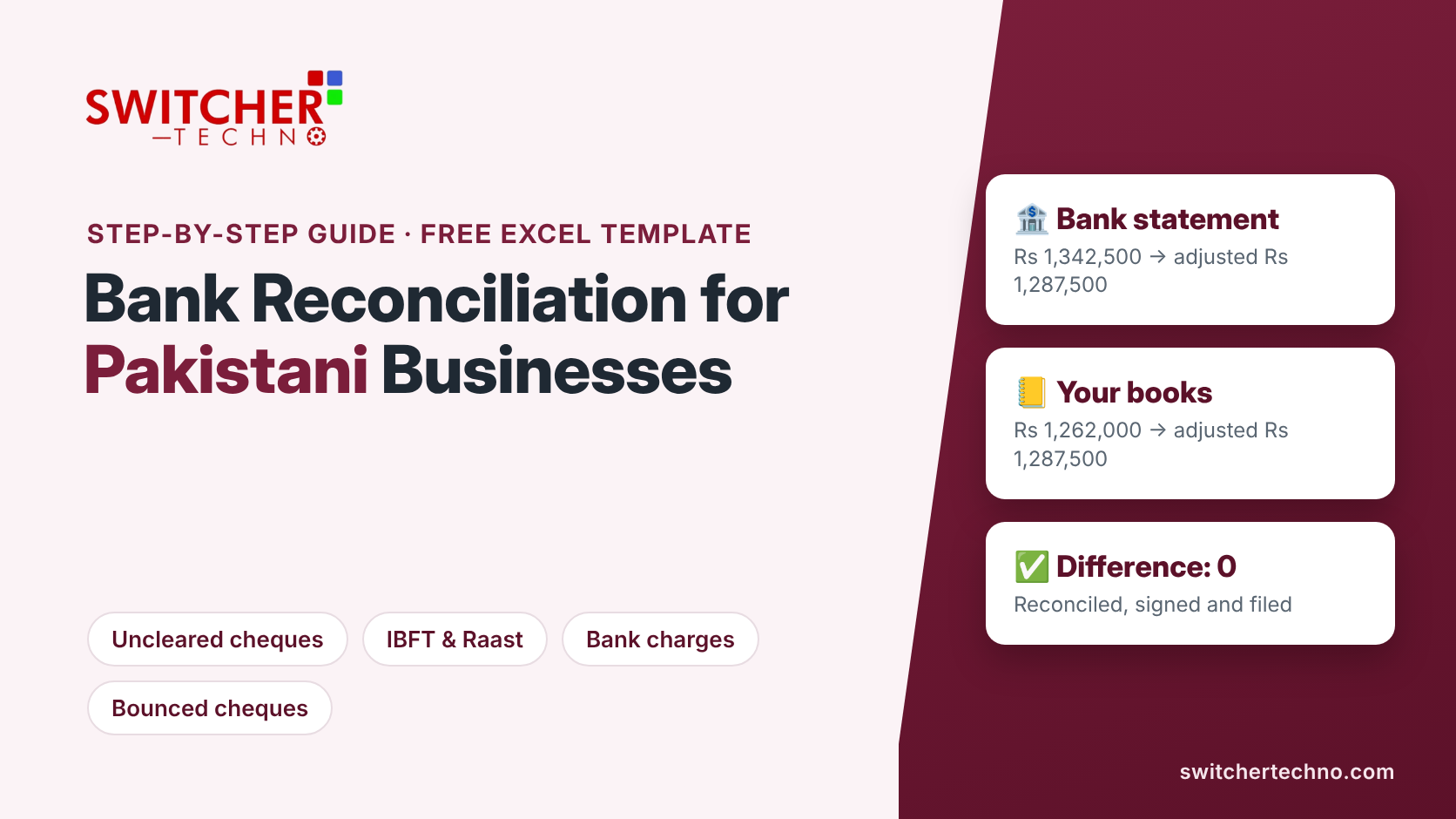
A trading company in Karachi closes October with these figures. The amounts are examples only.
| Bank side | Rs |
|---|---|
| Balance as per bank statement, 31 October | 1,342,500 |
| Add: cheque from a customer deposited on 31 October, not yet cleared | 150,000 |
| Less: cheques issued to a supplier (Rs 120,000) and for rent (Rs 85,000), not yet presented | (205,000) |
| Adjusted bank balance | 1,287,500 |
| Book side | Rs |
|---|---|
| Balance as per cash book, 31 October | 1,262,000 |
| Add: customer payment received by IBFT, not yet recorded | 40,000 |
| Add: profit credited on the savings account | 3,000 |
| Less: bank charges and SMS fees | (1,500) |
| Less: customer cheque returned unpaid | (16,000) |
| Adjusted book balance | 1,287,500 |
Both sides show Rs 1,287,500, so the account is reconciled. The four book-side items are then entered in the accounts, and the customer whose cheque bounced is charged back Rs 16,000.
How often should you reconcile?
- Monthly for every bank account, as a minimum, before you close the month.
- Weekly for your main collection account if customers pay by online transfer, so receipts are allocated quickly.
- Daily for very busy accounts, such as a retail chain’s card settlements or a distributor collecting hundreds of cheques.
Five common mistakes
- Forcing the difference. Posting an unexplained difference to “suspense” or “miscellaneous” hides the problem. Find the cause.
- Treating tax deducted by the bank as an expense. Many bank deductions can be adjusted against your income tax, depending on the type of deduction. Record them in an advance tax account so your tax adviser can claim what is allowed in your return.
- Ignoring old unpresented cheques. A cheque that has not been presented for months may have been lost or may never be cashed. Follow up and reverse it if needed.
- Not charging back bounced cheques. If the receipt is not reversed, the customer’s balance looks paid when it is not.
- Reconciling only at year end. By then, twelve months of differences are mixed together and much harder to trace.
Where accounting software helps
A spreadsheet works for one account with a few dozen transactions. When you have several banks, hundreds of cheques and customers paying by IBFT, good accounting software saves hours: receipts are posted straight to the customer’s account, cheques carry their numbers and dates, and the bank ledger, party ledgers and cash book stay in one place, so differences are easier to trace.
Setting up your books for the first time? Start with a clean chart of accounts that has a separate account for each bank and for advance tax.
A bank reconciliation is one part of a wider routine. See our month-end closing checklist for all 15 steps and a timetable built around FBR dates.
Customer cheques that are dated in the future should not reach the bank reconciliation until they are deposited. Track them first in a post-dated cheque (PDC) register.
Tired of chasing the bank balance?
Switcher Techno’s accounting and inventory software keeps your bank accounts, cash book and customer ledgers together, with local support from Karachi and Lahore since 2010. Book a free demo and bring last month’s bank statement.
Frequently asked questions
What is a bank reconciliation statement?
It is a statement that explains the difference between the bank balance in your books and the balance on your bank statement on the same date, so both can be confirmed as correct.
How often should a small business reconcile its bank account?
At least once a month for every bank account. Busy collection accounts are better reconciled weekly or even daily.
What are unpresented cheques?
Cheques you have issued and recorded in your books that the payee has not yet deposited or the bank has not yet paid. They are a timing difference and need no correcting entry.
How do I record a bounced cheque?
Reverse the receipt you recorded, add the amount back to the customer’s balance, and record any bank charge for the returned cheque as a bank charge.
How should I record tax deducted by the bank?
Record it in an advance income tax account rather than as an expense, because many bank deductions can be adjusted against your tax liability. Your tax adviser will confirm which ones can be claimed.
What if my bank reconciliation does not balance?
Check for transposed figures, entries posted twice, receipts posted to the wrong bank, items from the wrong month and missing bank charges. Never post the difference to a suspense account without explaining it.
This article and template are general guidance for Pakistani small businesses as at November 2026. Amounts are examples only. It is not accounting or tax advice; confirm the treatment of bank tax deductions and other items with a qualified accountant or tax adviser.
