
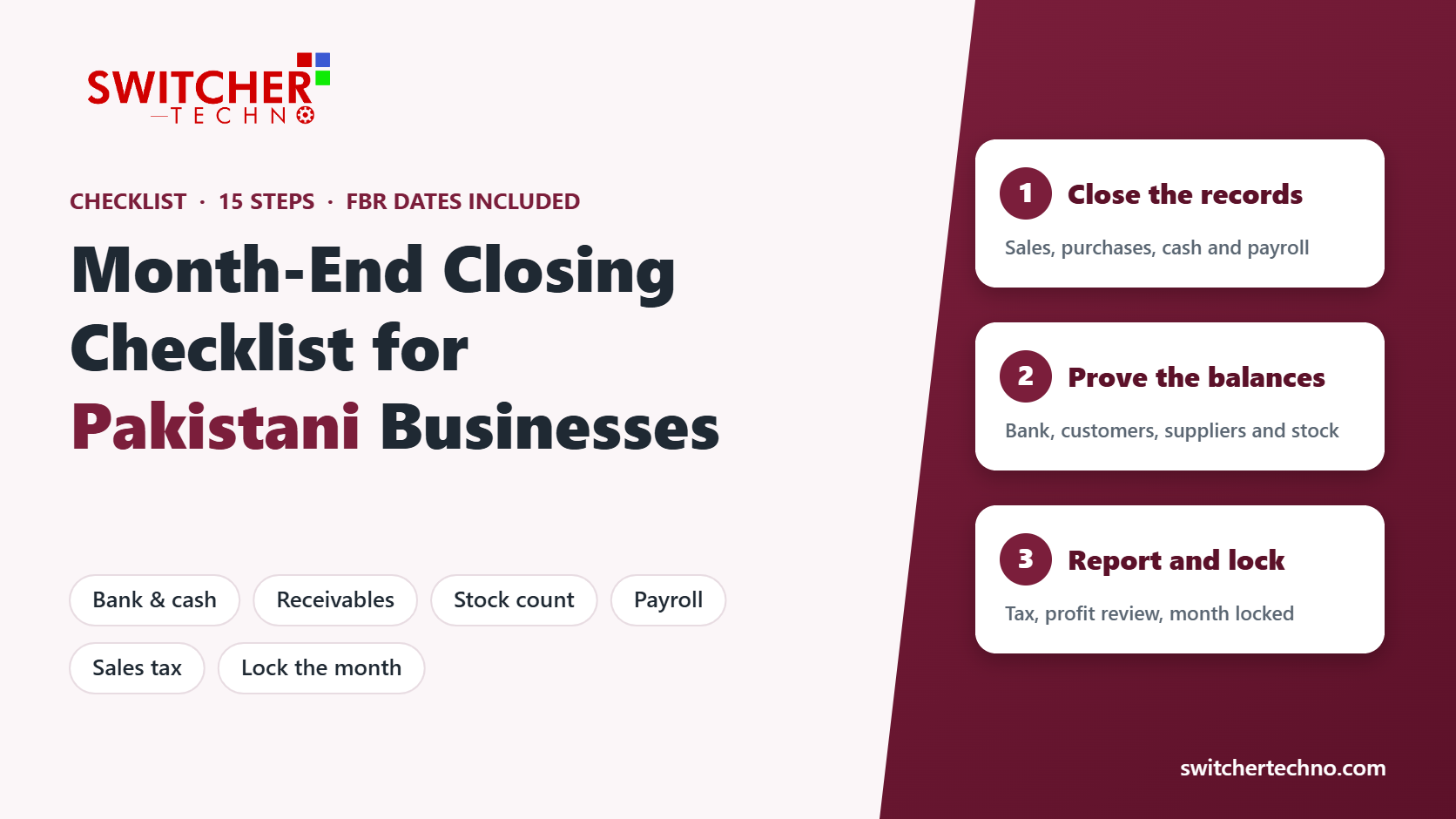
Month-End Closing Checklist for Pakistani Businesses: 15 Steps to Close Your Books on Time
In short: A good month-end close has three stages: finish the records, prove the balances against outside evidence, and then review and lock the month. Start on the first working day and aim to finish the checks before FBR’s Annexure-C date on the 10th, so that tax work is not rushed. This post gives you the 15 steps, a timetable and the mistakes to avoid.
Many Pakistani businesses only find out their real profit when the auditor or tax adviser arrives at year end. By then, a wrong bank entry from August is hard to trace and a stock shortage from March cannot be explained. A monthly close fixes this. It takes effort at first, but each month becomes quicker because the errors never pile up.
Why close the books every month?
- You see real profit. A month’s bank balance tells you little about whether you earned money that month.
- You catch errors and theft sooner. Cash and stock differences are much easier to investigate within weeks than after a year.
- You recover money faster. An up-to-date ageing report shows exactly who owes you and for how long.
- Tax filing gets calmer. Clean sales and purchase records make it easier to file sales tax on time and to prepare for the annual return.
- Physical stock count: step-by-step procedure
The 15-step month-end closing checklist
Copy this list into your own file and put a name and a date against each step.
Stage 1: Close the records
- Set the cut-off. Note the last sales invoice, delivery challan, goods received note (GRN), payment voucher and receipt of the month. Anything after these numbers belongs to next month.
- Post all sales. Match invoices with challans, enter credit notes for returns, and check that invoices required to go through FBR digital invoicing were actually accepted.
- Post all purchases and expenses. Enter supplier bills and expense vouchers. If goods have arrived but the bill has not, record it from the GRN so that stock and payables stay correct.
- Count and close cash. Count petty cash and the cash in hand, enter all vouchers, and explain any shortage rather than parking it in a suspense account.
Stage 2: Prove the balances
- Reconcile every bank account. Match your books with the bank statement, including uncleared cheques, IBFT and Raast receipts, and bank charges. Our bank reconciliation guide shows the method.
- Review customer balances. Run a receivable ageing report, apply unallocated receipts, separate post-dated cheques, and send balance confirmations to your biggest customers.
- Review supplier balances. Compare supplier statements with your ledger. Check advances, unpaid bills and supplier credit notes that have not been recorded.
- Count stock and value it. Compare the count with system quantities and post approved differences. Use the same valuation method every month; our FIFO vs weighted average guide explains the choice.
- Close payroll. Post salaries, overtime, advances and loan recoveries, along with income tax deducted and any EOBI or provincial social security contributions that apply to you.
- Record accruals and prepayments. Add expenses that belong to this month but are not yet billed, such as electricity, internet, rent or sales commission. Spread prepaid expenses over the months they cover.
- Post depreciation. Enter the monthly charge from your fixed asset register, and record any assets you bought or sold during the month.
Stage 3: Check tax, review and lock
- Reconcile sales tax. Agree output tax with your sales ledger, and input tax with your purchase ledger and Annexure-C. Our Annex-C reconciliation guide covers the common mismatches.
- Check withholding tax. List tax deducted from suppliers, salaries and rent, and tax others deducted from you. Confirm that it was deposited and that the certificates are on file.
- Review the reports. Compare profit and loss and the balance sheet with last month. Investigate sharp changes in gross margin, negative balances, and old items sitting in suspense or advances.
- Lock the month and save the file. Lock the period, then keep the reports and reconciliations together. Any later correction should go through a dated, approved entry.
A timetable that fits the FBR dates
The FBR sales tax due dates page sets out the standard monthly procedure: Annexure-C on the 10th, payment on the 15th, and e-filing of the return by the 18th of the following month. Certain categories of taxpayers follow different procedures, so check which one applies to you. Here is a sample plan built around those dates:
| When | What to finish | Steps |
|---|---|---|
| Working days 1 to 2 | Cut-off, sales, purchases, expenses and cash | 1 to 4 |
| Working days 3 to 4 | Bank, customers, suppliers and stock | 5 to 8 |
| Working days 5 to 6 | Payroll, accruals and depreciation | 9 to 11 |
| By the 10th | Sales tax reconciliation and Annexure-C | 12 |
| By the 15th | Sales tax payment and withholding tax check | 13 |
| By the 18th | Sales tax return e-filed; reports reviewed and month locked | 14 to 15 |
Published guides currently disagree on the timing of the withholding tax statement under section 165 of the Income Tax Ordinance: some describe it as monthly and others as quarterly. Please confirm the current requirement with your tax adviser or on IRIS instead of relying on a blog, including this one.
Example: how adjustments change your profit
Here is an illustrative example with made-up figures. A trading company’s system shows a profit of Rs 900,000 for October before any month-end adjustments:
| Item | Amount (Rs) |
|---|---|
| Profit before adjustments | 900,000 |
| October electricity, bill received in November | (85,000) |
| Stock shortage found in the count | (40,000) |
| Sales commission for October, not yet paid | (60,000) |
| Monthly depreciation | (50,000) |
| Actual profit for October | 665,000 |
That is Rs 235,000 less than the owner thought. Without a close, those costs would land in later months, or stay hidden until year end, and decisions on pricing and spending would be based on the wrong number.
Mistakes that slow down the close
- Late paperwork. Set a simple rule that branches and salespeople submit all bills and vouchers by the 1st or 2nd of the month.
- A growing suspense account. Treat it as a list of open questions, and clear it each month.
- Editing closed months. If old figures keep changing, you can no longer trust any comparison or tax working.
- One person doing everything. Where you can, have someone else review the bank reconciliation and stock adjustments, so errors and misuse are easier to catch.
- Treating stock as a year-end job. Rolling counts of your important items catch problems while you can still act on them.
Excel or accounting software for your close?
A very small business with few transactions can run this checklist in Excel. The weak points appear as volume grows: figures are typed more than once, stock does not update itself, and anyone can change an old month. Good accounting software posts sales, purchases and stock to the ledgers as you work, produces ageing reports on demand, and can lock closed periods. It will not replace the discipline of counting stock or reviewing balances, though. Whichever software you consider, ask to see a period lock, an ageing report and a bank reconciliation in the demo.
Want your books closed in days, not weeks?
Switcher Techno’s accounting and inventory software keeps sales, purchases, stock, bank and customer ledgers in one place, with local support from Karachi and Lahore since 2010. Book a free demo and bring last month’s closing problems with you.
Frequently asked questions
What is month-end closing in accounting?
It is the routine of recording every transaction for the month, checking balances against outside evidence such as bank statements and stock counts, adding adjustments, and then locking the month so the reports stop changing.
How long should a month-end close take?
There is no fixed rule. A small trading business can often aim for about five to seven working days. If yours takes longer, look at where work is waiting, which is usually bank entries, supplier bills or stock.
Can a small business close its books without an accountant?
The owner or a bookkeeper can do most of the routine steps with a clear checklist. Have a qualified accountant or tax adviser review adjustments, tax figures and anything you are unsure about, at least periodically.
What are the FBR sales tax dates to plan the close around?
Under the standard procedure described on the FBR website, Annexure-C is filed on the 10th, payment is made on the 15th, and the return is e-filed by the 18th of the following month. Some taxpayer categories follow different procedures, so confirm yours.
Do I need a full stock count every month?
Not always. Many businesses count fast-moving or high-value items monthly and the full stock less often. Do a full count at least at year end, and whenever the differences you are finding become large.
What does locking the month mean?
It means nobody can add or change entries in that period without approval. In accounting software this is usually a period lock setting. In Excel, you can save a read-only copy of the final file, although that is easier to bypass.
FBR sales tax dates were checked on the FBR website on 4 November 2026. Figures in the example are illustrative. This article is general guidance, not tax, legal or accounting advice. Please confirm your own obligations with a qualified adviser.
