
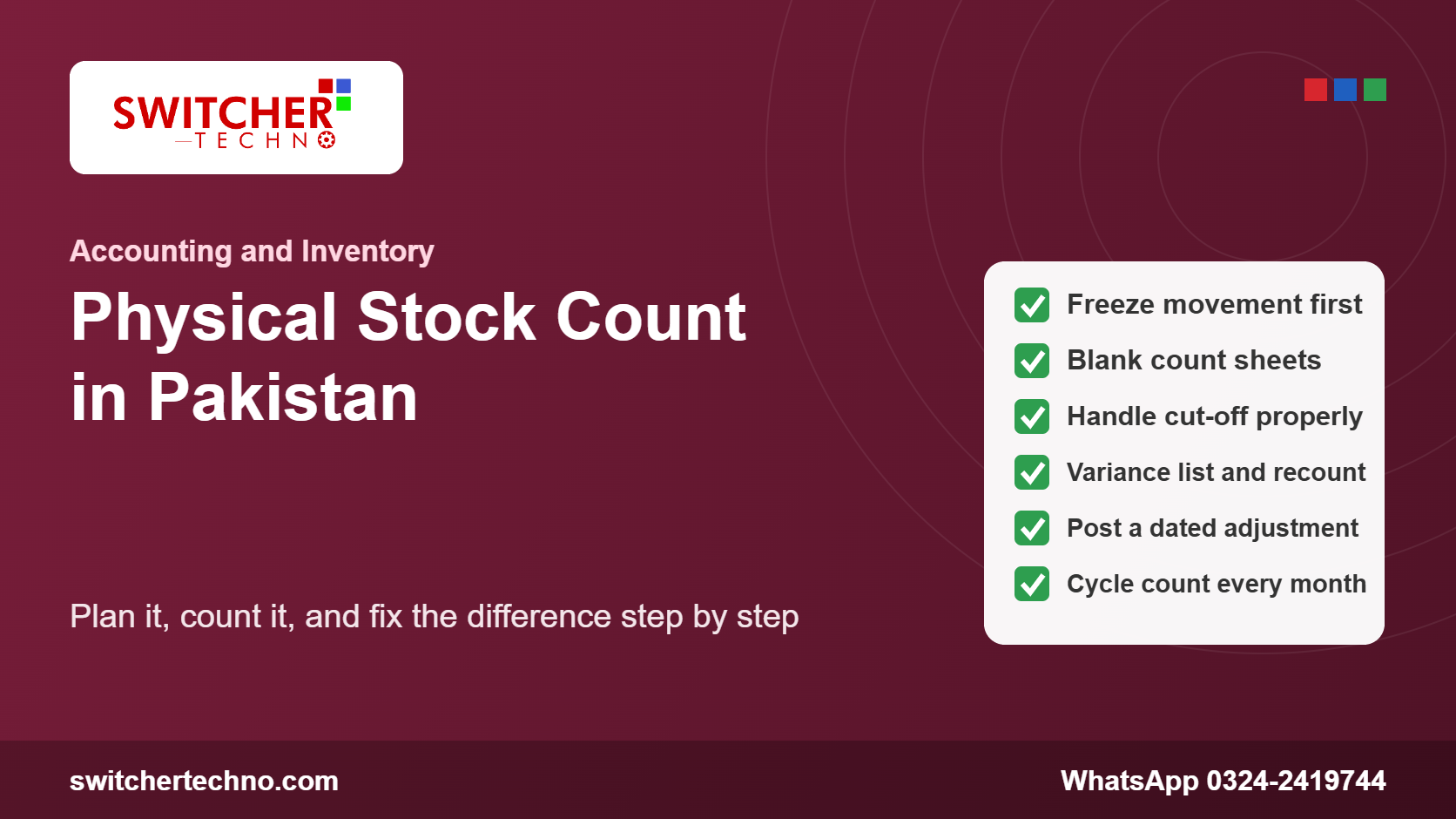
Physical Stock Count in Pakistan: A Step-by-Step Guide for Shops and Warehouses
In short: A physical stock count means stopping movement for a short window, counting what is actually on the shelves, and comparing it with what your records say. Most Pakistani businesses only discover theft, wrong rates and dead stock when they do this properly. This guide covers how to plan the count, how to count without double-counting, how to handle cut-off, and what to do with the difference you find.
Why the count matters more than most owners think
Your purchase register tells you what came in. Your sales register tells you what went out. The difference is what should be lying in the shop or warehouse. When you finally count, the number is almost never the same, and the gap is where your money has been leaking.
Three things usually show up in the first serious count: items that were sold but never entered, items that were entered at the wrong rate or wrong unit, and items nobody has asked for in a year. The first is a control problem, the second is a data problem, and the third is cash sitting on a shelf. You cannot fix any of them until you have counted.
Before the count: five things to settle
- Date and time. Pick a day when movement is lowest, usually after closing or on a weekly off. Tell your suppliers in advance that no deliveries will be received that day.
- Scope. Full count of everything, or a section at a time? A shop can usually do everything in one night. A warehouse with thousands of items is easier to handle rack by rack over a few days, as long as no stock moves between counted and uncounted areas.
- Teams. Two people per area: one counts, one writes. Never let the person who controls an area count that area alone.
- Count sheets. Print item name, code, pack size and unit, but leave the quantity column blank. If your staff can see the expected number, many will simply copy it.
- Clean-up first. Group the same item lying in different places, pull out damaged and expired goods, and keep anything belonging to a customer or supplier clearly separate.
How to run the count, step by step
- Freeze movement. No sales, no deliveries in, no returns out while counting. If a sale must happen, write it on a separate slip and enter it after the count is closed.
- Mark the areas. Give every rack, shelf or room a number, and count in that order. Mark each area with tape or a slip once it is finished so nobody counts it twice.
- Count by unit, not by guess. Agree on whether you are counting pieces, packs or cartons, and write the unit on the sheet. Mixing cartons and pieces is the most common cause of a huge fake difference.
- Enter the counted figures. Put the physical quantity into your system as a stock-take or physical-stock entry, not by editing opening balances.
- Print the variance list. List only the items where counted and system quantities differ, with the value of each difference.
- Recount the big gaps. Anything with a large value difference gets a second count by a different person, before you accept the number.
- Approve and post the adjustment. The owner or manager signs the final variance list, and only then is the adjustment posted so the books match the shelves.
Cut-off: the part most counts get wrong
Cut-off means deciding which transactions belong before the count and which belong after. Goods received on the day but not yet entered, delivery challans issued but not invoiced, and items returned by a customer lying at the counter all cause differences that look like theft but are only timing.
Keep three trays on count day: received but not entered, delivered but not invoiced, and returns not yet taken back into stock. Deal with those three trays before you print the variance list, and most of the alarming numbers disappear.
What to do with the difference
A variance list is not an accusation, it is a to-do list. Work through it in this order:
- Data errors first. Wrong unit, wrong pack size, the same item entered twice under two codes. Fix the master data, not just the quantity.
- Process errors next. Sales made without a bill, goods issued on a verbal order, samples given away without an entry. Each one needs a rule, not a scolding.
- Real shortage last. Whatever remains after the first two is a genuine loss. Record it, value it, and decide whether it needs a change in who holds the keys.
Once the adjustment is posted, your stock value is reliable again, which is what makes your profit figure reliable. Good accounting software keeps the count as a separate, dated entry so you can see exactly what was adjusted and by whom, instead of quietly changing old balances.
How often should you count?
A full count once a year is the minimum, and most owners do it at the close of their financial year. A better habit is cycle counting: count a small group of items every week so that fast movers and expensive items are checked many times a year and the full count holds no surprises.
A simple rotation that works for most shops in Pakistan is to count your top-selling and highest-value items every month, mid-range items every quarter, and the long tail once a year.
Want your stock count to actually match your books?
Send us a message on WhatsApp and we will show you how a stock-take entry works in our software, how the variance report looks, and how to set up cycle counting for your shop or warehouse. Local support from Karachi.
Frequently asked questions
What is a physical stock count?
It is the process of physically counting every item you hold and comparing that count with the quantity your records show, then adjusting the records to match reality.
Do I have to close the shop to count stock?
Not necessarily, but movement must stop in the area being counted. Most shops count after closing hours or on a weekly off so no sale or delivery happens in the middle of a count.
How do I count if items are lying in two or three places?
Either bring them together before the count, or count each location separately on its own sheet and add the totals for that item at the end. Never count from memory.
What is cycle counting?
Counting a small set of items regularly instead of everything at once. Fast-moving and high-value items are counted most often, slow movers least often, so errors are caught early.
Should staff see the system quantity on the count sheet?
No. If the expected figure is printed on the sheet, counters tend to copy it instead of counting. Print the item details and leave the quantity column blank.
What do I do with expired or damaged goods found during the count?
Keep them physically separate and list them separately. They should not be counted as good stock, and the write-off or supplier-return decision is taken after the count.
This guide explains general stock-taking practice for businesses in Pakistan. It is not audit or tax advice. For your own financial statements, follow the procedure agreed with your auditor.
