
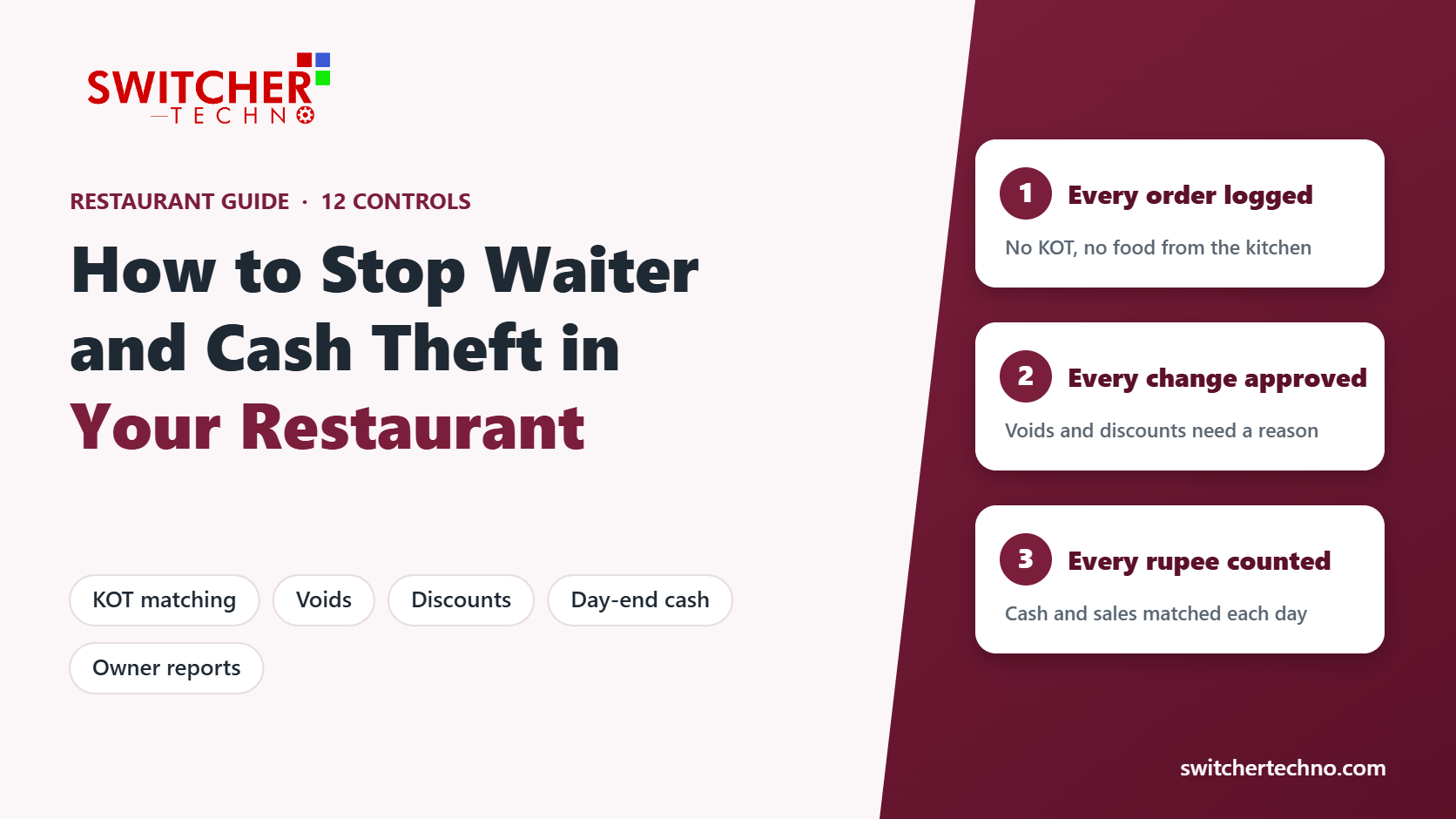
How to Stop Waiter and Cash Theft in Your Restaurant: 12 Controls for Pakistani Owners
In short: Most restaurant theft happens where an order, a bill and the cash are not matched. Fix that by recording every order, printing every bill, controlling voids and discounts, counting cash at every shift and reviewing exceptions yourself. These 12 controls work on paper or in software, and they protect honest staff as well as your profit.
Many owners only suspect a problem when sales feel low on a busy night or the cash never seems to match. The difficulty is that small losses look normal. A cancelled order here and a free meal there rarely attract attention, but they add up. This guide explains where the money usually leaks and what to change, without treating your whole team as suspects.
Where the money usually leaks
| What happens | Warning sign | What stops it |
|---|---|---|
| Food served without a bill | Stock used is higher than sales suggest | No KOT, no food; match KOTs to bills |
| Bill cancelled after the cash is collected | Many voids by one person or late in the shift | Approval and a reason for each void |
| Unauthorised discounts | Discount total keeps rising | Limits by role; weekly discount report |
| Cash short at the counter | Regular small differences | Counted float and signed shift counts |
| Delivery cash not handed over | Rider balances remain open | Daily rider settlement against orders |
| Stock leaving through the back door | High usage of costly items | Regular counts and recipe-based usage checks |
12 controls that close the gaps
- Make the order the starting point. Food and drinks should leave the kitchen only against a recorded order or kitchen order ticket (KOT). No KOT, no food.
- Give every staff member a separate login or ID. Shared logins mean nobody is responsible. Each order, void and discount should show who did it.
- Print a bill for every table. The customer should receive a printed bill every time. Tell customers on the menu or table card to ask for one, because this adds a check that you do not have to pay for.
- Match KOTs to bills every day. Any KOT without a bill needs an explanation. This is the fastest way to catch food sold without billing.
- Control voids and cancellations. After an order goes to the kitchen, cancelling it should need a manager’s approval and a reason. Review voids by staff member each week.
- Limit discounts. Set who can give what. Record every complimentary meal and staff meal against a named person.
- Separate order-taking from cash handling. Where staff numbers allow, the person who takes the order should not also collect and record the cash.
- Count the cash at every shift change. Start each shift with a counted float. At the end, compare the cash with the system total, record any difference, and have both people sign.
- Reconcile card, wallet and delivery payments. Match card machine and wallet receipts with the sales report, and check delivery rider cash against delivered orders each day.
- Count high-value stock regularly. Count meat, cooking oil and other costly items often, then compare what you used with what your sales and recipes suggest. Our recipe costing guide shows how.
- Rotate duties and take surprise checks. Change who does which task from time to time, and sometimes check the float or a shift report without notice. This protects honest staff as well.
- Review exception reports yourself. Look at voids, discounts, cash differences and sales by staff member. An owner reviewing these regularly sends a clear message that someone is watching the numbers.
A 15-minute daily owner check
You do not need to watch the counter all day. Every morning, review these for the previous day:
- Total sales compared with cash, card, wallet and delivery receipts
- Number and value of voids, and who made them
- Total discounts and complimentary meals
- Any cash difference from each shift
- KOTs with no matching bill
Ask about anything unusual on the same day, while people still remember what happened. A question asked calmly today works better than an accusation months later.
What small leaks cost
Here is an illustrative example with made-up figures. If a restaurant loses just Rs 3,000 a day through unbilled food, wrong voids and cash shortages, that is Rs 90,000 in a 30-day month and about Rs 1,080,000 in a year. For many restaurants, that could pay for several months of a salary or a kitchen upgrade.
Do not treat a single difference as proof of theft, because rush hours and honest mistakes can cause errors. Look for repeated patterns, check the records and talk privately. Explain the controls to everyone in advance, so they see them as rules for the whole restaurant.
Paper or software?
A small cafe can begin with numbered KOT books, a shift cash sheet and a daily register, but matching them by hand takes time, and pages can go missing. Good restaurant software makes these checks easier because orders, bills, voids, discounts and shift totals can be recorded in one place. Software will not stop theft by itself, though: someone still has to count the cash and read the reports. Whichever system you consider, ask the vendor to show you user rights, void and discount reports, and a shift closing in the demo. To plan the cost, see our guide to restaurant software prices in Pakistan.
Most of these tricks show up the same night if the day is closed properly. Use our restaurant end-of-day closing checklist.
Want to see where your restaurant’s cash is going?
Switcher Techno’s restaurant software helps you keep orders, bills and reports together, with local support from Karachi and Lahore since 2010. Book a free demo and bring your biggest counter problem with you.
Frequently asked questions
Is restaurant theft always done by waiters?
No. Losses can come from anyone who handles orders, cash, stock or discounts, including cashiers, kitchen staff, store staff and managers. Some losses are honest mistakes. That is why the controls should apply to every role.
What is the most important control to start with?
Start with the rule that no food leaves the kitchen without a recorded order. It is simple, and it creates a record you can match against bills and cash.
How often should cash be counted?
Count cash at the end of every shift, and whenever the cashier changes. Both people should sign the count, so each one is responsible only for their own shift.
Should staff be allowed to give discounts?
Set clear limits. Fixed offers can be applied by the cashier, while any other discount should need a manager’s approval and a recorded reason. Review the discount report regularly.
Can CCTV alone stop cash theft?
It helps with deterrence and with investigating a specific incident, but nobody can watch every hour of footage. It works best alongside order records, cash counts and exception reports that show you where to look.
What should I do if I suspect an employee?
Check the records first and look for a repeated pattern before accusing anyone. Speak to the person privately with a witness, and take advice on any legal or disciplinary step. A wrong accusation can damage a good employee and your team.
Figures in the example are illustrative. This article is general guidance, not legal or HR advice. Please take qualified advice before taking action against an employee. Published 6 November 2026.
