
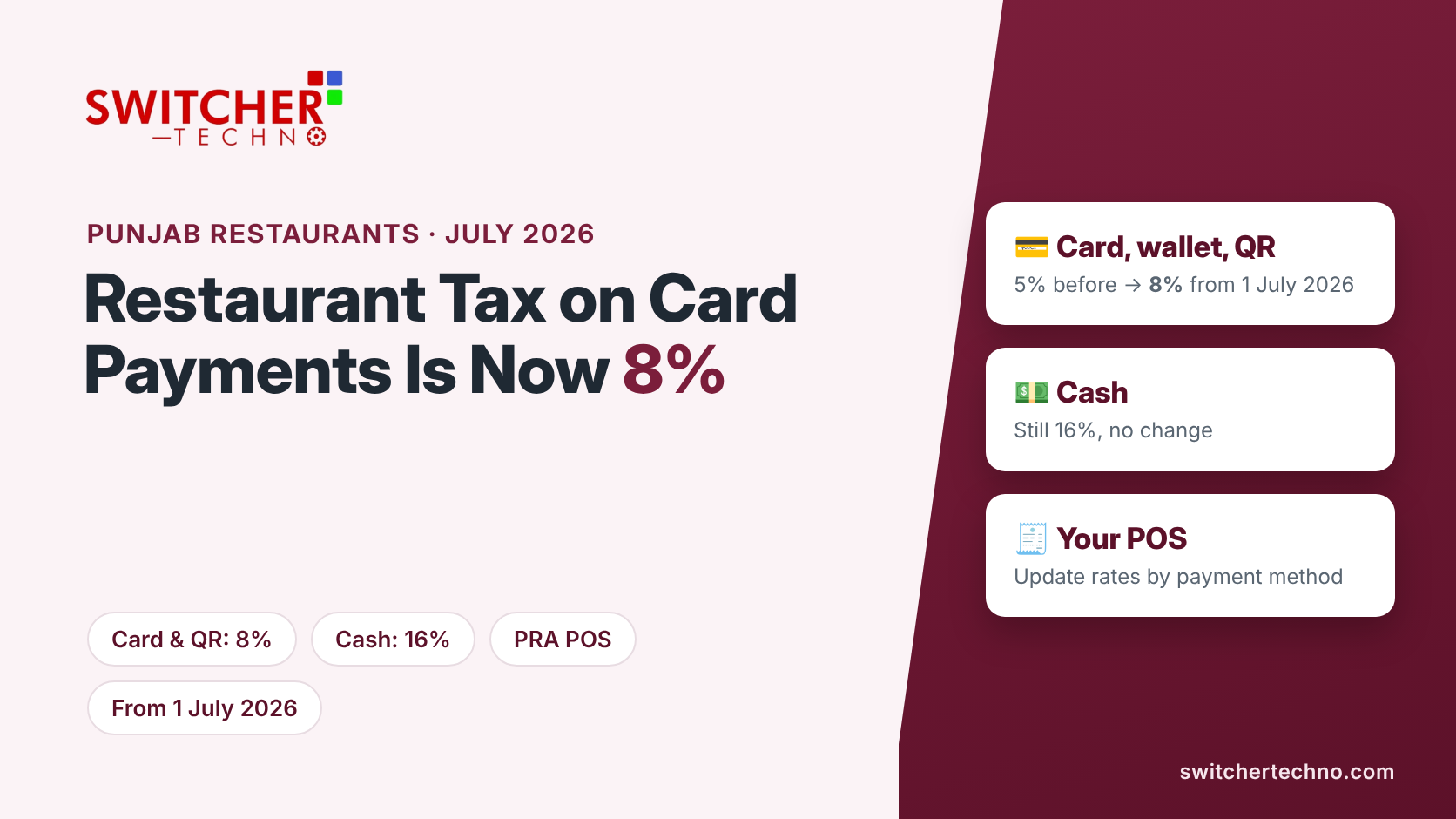
Punjab Restaurant Tax on Card Payments Is Now 8%: What Restaurant Owners Must Change (2026)
In short: From 1 July 2026, under the Punjab Finance Act 2026, restaurant bills in Punjab paid by debit card, credit card, mobile wallet or QR code are taxed at 8%, up from 5%. Bills paid in cash are still taxed at 16%. Restaurants need to update the tax rate in their POS, make sure every PRA invoice shows the right rate, and train cashiers to explain the change to customers.
For the last few years, Punjab gave restaurant customers a strong reason to pay by card: 5% tax instead of 16% in cash. That gap has now narrowed. The Punjab Revenue Authority (PRA) has raised the rate on digital payments to 8%, and restaurants that have not updated their billing are either charging customers the wrong amount or under-paying tax.
This guide explains exactly what changed, what it means on a real bill, and the steps every restaurant, cafe and fast-food outlet in Punjab should take now.
What changed on 1 July 2026
| How the customer pays | Before 1 July 2026 | From 1 July 2026 |
|---|---|---|
| Debit or credit card | 5% | 8% |
| Mobile wallet or QR code | 5% | 8% |
| Cash | 16% | 16% (no change) |
The change was made through the Punjab Finance Act 2026 and applies to dine-in and takeaway bills paid through eligible digital channels. A PRA spokesperson told Geo Fact Check that the rate was raised to bring Punjab in line with other provinces.
What it means on a real bill
Take a family dinner with a bill of Rs 5,000 before tax:
| Payment | Tax rate | Tax | Total bill |
|---|---|---|---|
| Card, before 1 July 2026 | 5% | Rs 250 | Rs 5,250 |
| Card, from 1 July 2026 | 8% | Rs 400 | Rs 5,400 |
| Cash | 16% | Rs 800 | Rs 5,800 |
A card customer now pays Rs 150 more on this bill than before. Paying by card still saves Rs 400 compared with cash, so it is still worth telling customers about the lower rate.
Print a test bill paid by card from your POS. If it still shows 5% tax, your system has not been updated and every card bill since 1 July 2026 has been under-taxed.
6 things restaurant owners in Punjab should do now
- Update the tax rate by payment method. Set 8% for card, mobile wallet and QR payments and keep 16% for cash. The POS should apply the rate automatically when the cashier selects the payment method, not rely on the cashier to remember.
- Check your PRA invoices. Restaurants that PRA requires to integrate must issue each bill through a PRA-integrated POS. Confirm that the invoice reported to PRA, the printed bill and the QR code all show the same rate and tax amount.
- Decide how to handle split payments. When a table pays partly by card and partly in cash, your POS must record both payments on one bill. Confirm with PRA or your tax adviser how the tax should be worked out in that case, then set the POS to do it the same way every time.
- Update menus and notices. Many restaurants print “5% tax on card payments” on menus, table tents and the website. Replace these with the new rate to avoid arguments at the counter.
- Brief your cashiers and waiters. Customers who remember the 5% rate will ask why the bill is higher. A one-line answer (“the Punjab government raised it to 8% from 1 July”) saves time and complaints.
- Reconcile before you file. At month end, compare tax collected by payment method in your POS report with the figures in your PRA return. Any difference usually means some bills were still charged at the old rate.
Is PRA POS integration compulsory for my restaurant?
PRA requires restaurants that fall under its rules to issue bills through a POS integrated with its system, so each invoice is reported in real time and carries a PRA invoice number and QR code. If you are not sure whether your restaurant is covered, read our guide to PRA POS integration in Punjab or confirm with PRA directly.
How other provinces compare
Restaurant tax is a provincial matter, so the rate depends on where the restaurant is, not where the customer lives.
- Sindh (SRB): the standard rate on restaurant services is 15%. SRB has said a reduced 8% rate applies when customers pay by card or other digital methods, while some large restaurants with SRB-integrated POS have SRB permission to charge 15% on all bills. See SRB POS integration for restaurants.
- Islamabad (ICT): restaurants pay tax on services under the ICT law, collected by FBR, which also gives a lower rate for digital payments. Confirm the current rate with FBR.
- Khyber Pakhtunkhwa (KPRA) and Balochistan (BRA): each authority sets its own rates and rules. Check the latest notification before you change your POS settings.
Why the rate change is a POS problem, not just a tax problem
Most restaurants did not decide to charge the wrong tax after 1 July 2026. Their billing software simply kept the old rate. A restaurant that bills 300 card orders a day at an average of Rs 3,000 under-collects about Rs 27,000 a day at 5% instead of 8%, and that shortfall still has to be paid to PRA.
A good restaurant POS software lets you change a rate once, applies it by payment method on every bill, reports each invoice to PRA and gives you a tax report by payment type for your return.
Need your POS updated for the new Punjab rate?
Switcher Techno’s restaurant POS applies the right PRA rate for cash, card, wallet and QR payments, with KOT, table management and recipe costing built in. Our Lahore team can update and integrate your system.
Frequently asked questions
What is the restaurant sales tax rate in Punjab in 2026?
From 1 July 2026, restaurant bills in Punjab are taxed at 8% when paid by debit card, credit card, mobile wallet or QR code, and at 16% when paid in cash.
When did the 8% rate on card payments start?
The 8% rate started on 1 July 2026 under the Punjab Finance Act 2026. Before that, card and digital payments at restaurants were taxed at 5%.
Which payment methods count as digital payments?
Debit cards, credit cards, mobile wallets and QR code payments qualify for the lower 8% rate. Cash is taxed at 16%.
Has the tax on cash payments changed?
No. Restaurant bills paid in cash in Punjab are still taxed at 16%.
Does the new rate apply to takeaway orders?
Yes. The 8% rate applies to dine-in and takeaway bills paid through eligible digital payment methods.
Do I need to change my restaurant POS settings?
Yes. Update the tax rate for card, wallet and QR payments to 8%, keep cash at 16%, and check that the invoices reported to PRA show the same rate as your printed bills.
This article is general information for Punjab restaurants as at November 2026, based on Profit (1 July 2026) and Geo Fact Check (16 July 2026). It is not tax advice; confirm rates and your obligations with PRA or a qualified tax adviser.
