
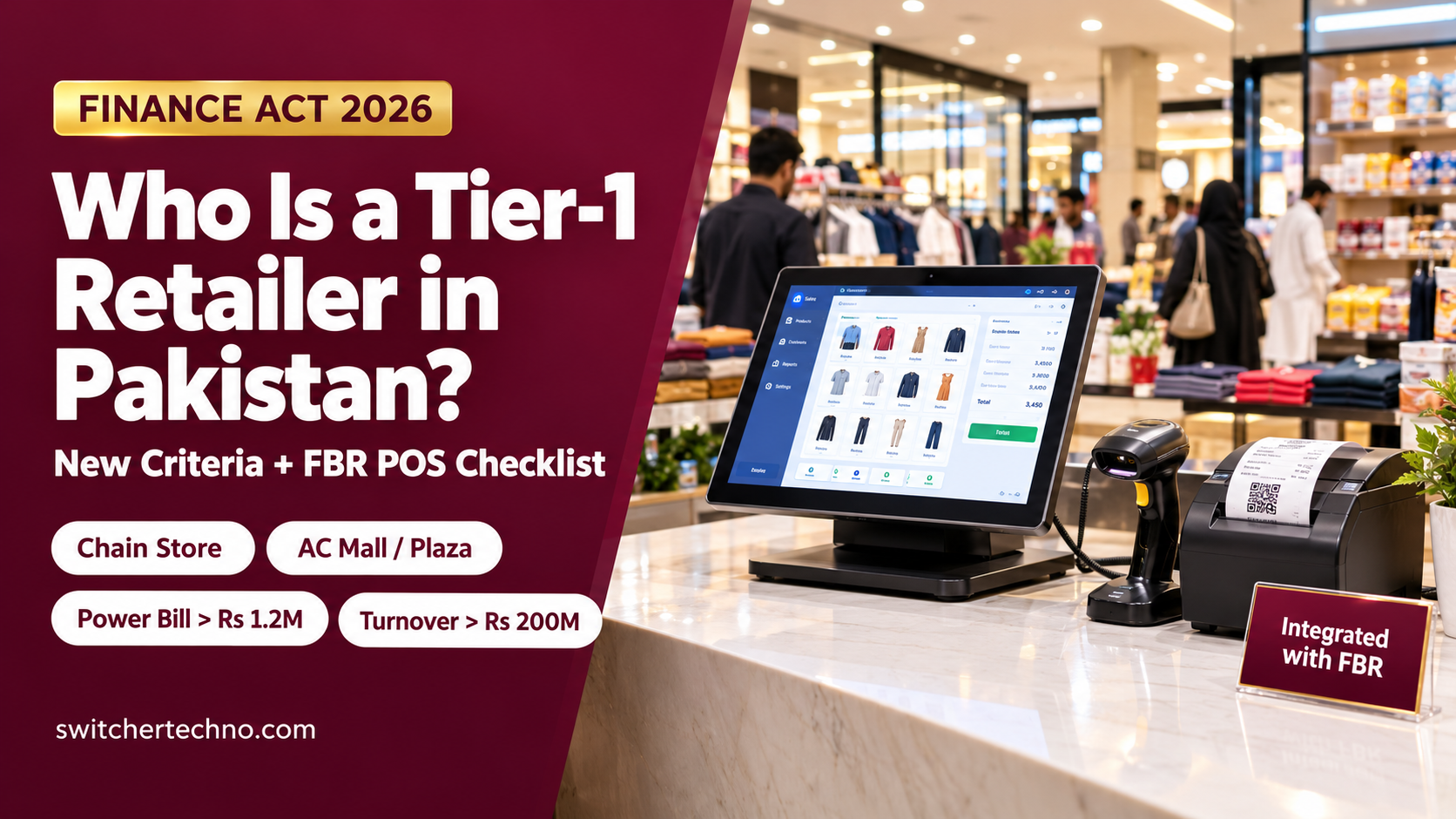
Who Is a Tier-1 Retailer in Pakistan? Finance Act 2026 Criteria & FBR POS Checklist
In short: From 1 July 2026, the Finance Act 2026 changed who counts as a Tier-1 retailer under the Sales Tax Act, 1990. You are Tier-1 if you meet any one of these tests: you are part of a national or international chain, you run a shop in an air-conditioned mall or plaza, your electricity bills for the last 12 months exceed Rs 1.2 million, or your turnover for the last 12 months exceeds Rs 200 million. Simply having a card machine no longer makes you Tier-1. If you are Tier-1, every sale must go through a point-of-sale (POS) system integrated with FBR in real time. This guide explains each test, what changed, what integration involves, and the penalties for getting it wrong.
What is a Tier-1 retailer?
A Tier-1 retailer is a retailer that falls within the definition in Section 2(43A) of the Sales Tax Act, 1990. FBR uses this category for large, organised retail businesses. Tier-1 retailers must register for sales tax, charge sales tax on retail sales, and issue every invoice through a POS system that is connected to FBR in real time. Smaller shops that do not meet any of the tests are not Tier-1 and are not required to integrate their POS with FBR.
The key word in the definition is “any”. You do not need to meet all the tests. If even one applies to your business, you are a Tier-1 retailer.
The Tier-1 retailer criteria after Finance Act 2026
The definition below applies from 1 July 2026, as amended by the Finance Act 2026. It is taken from FBR’s Sales Tax Act updated up to 30 June 2026.
| Test | You are Tier-1 if… | Typical example |
|---|---|---|
| Chain store | Your outlet is a unit of a national or international chain of stores | A branch of a garment brand, a supermarket chain or a franchise outlet |
| Air-conditioned mall or plaza | You operate in an air-conditioned shopping mall, plaza or centre (kiosks are excluded) | A shoe shop inside a mall such as Dolmen, Packages or Centaurus |
| Electricity bill | Your total electricity bills for the preceding 12 consecutive months exceed Rs 1.2 million | A large standalone store averaging over Rs 100,000 a month in electricity |
| Turnover | Your turnover in the preceding 12 consecutive months exceeds Rs 200 million, either by your own declaration or as worked back from tax deducted under Section 236G or 236H of the Income Tax Ordinance | A high-volume electronics, mobile or grocery outlet |
| Wholesaler-cum-retailer | You import and sell consumer goods in bulk to retailers and also sell directly to consumers, and your turnover exceeds Rs 200 million | An importer-distributor with its own retail counter |
| FBR notification | FBR has notified you, or your class of business, as Tier-1 | Sectors FBR brings in through a notification |
The Finance Act 2026 also added a proviso that lets FBR exclude a person or class of persons from the Tier-1 definition through a notification in the official Gazette.
Rs 1.2 million over 12 months is an average of Rs 100,000 a month. Add up your last 12 electricity bills for the premises. If the total is above Rs 1.2 million, you meet this test even if your shop is not in a mall and not part of a chain.
What changed on 1 July 2026
Many older articles, and even some consultant guides published in 2026, still list the old criteria. Here is what the Finance Act 2026 actually changed, as shown in the footnotes of FBR’s updated Sales Tax Act:
| Criterion | Before 1 July 2026 | From 1 July 2026 |
|---|---|---|
| Card or digital payment machine | Acquiring a card or digital payment point of sale made you Tier-1 | Removed. A card machine alone no longer makes you Tier-1 |
| Withholding under 236G / 236H | Tier-1 if tax deducted on your purchases crossed an FBR threshold (Rs 100,000 or Rs 500,000 under SRO 2071(I)/2025) | Replaced by a turnover test: over Rs 200 million in the preceding 12 months, declared or worked back from that withholding |
| Wholesaler-cum-retailer | Covered without a turnover limit | Covered only if turnover exceeds Rs 200 million |
| Exclusions | No express power | FBR can exclude persons or classes by Gazette notification |
| Shop area (1,000 sq ft) | Already removed by the Finance Act 2023. Floor area is not a test any more. | |
The chain store, air-conditioned mall and Rs 1.2 million electricity tests did not change.
Are you a Tier-1 retailer? A 5-question self-check
- Is your outlet part of a chain? If you run several branches under one brand, or a franchise of a national or international brand, the answer is likely yes.
- Is your shop inside an air-conditioned mall, plaza or centre? Kiosks are excluded, but a regular shop in an air-conditioned building is covered.
- Did your electricity bills in the last 12 months total more than Rs 1.2 million? Add up the bills for the premises, not just one month.
- Was your turnover in the last 12 months above Rs 200 million? Remember that FBR can work this out from the tax your suppliers and distributors deducted under Section 236G or 236H, even if you never declared it.
- Has FBR notified your sector? Check FBR notices for your line of business.
If you answered yes to any one question, treat your business as Tier-1 and plan for POS integration. If all five answers are no, you are not Tier-1 under the current definition. For such shops, FBR has notified a voluntary 1% income tax scheme for shopkeepers with turnover up to Rs 200 million, and Tier-1 retailers are excluded from it (SRO 1166(I)/2026).
What a Tier-1 retailer must do
The duty to integrate now sits in Section 23(6) of the Sales Tax Act, as explained in FBR’s Circular No. 02 of 2025-26. The day-to-day requirements are in Chapter XIV of the Sales Tax Rules, 2006, replaced by SRO 69(I)/2025. In plain terms:
- Register and integrate. Register for sales tax, then install POS hardware and software that is integrated with FBR’s system.
- Declare your outlets and machines. Give FBR the details of every outlet and every POS machine through its online system.
- Sell only through integrated outlets. The rules say no supply can be made except through integrated outlets. A side counter or a manual bill book is not allowed.
- Report in real time. Each invoice must reach FBR in real time and carry an FBR invoice number and a QR code that customers can verify on FBR’s Tax Asaan app.
- Display the sign. Put up the “Integrated with FBR” signboard at the outlet.
- Collect the POS service fee. Integrated Tier-1 retailers add Rs 1 per invoice as the POS service fee under SRO 1279(I)/2021.
- Charge the correct sales tax. The standard rate is 18%, unless your goods have a different rate under the law.
- Accept digital payments when required. Rule 150R(7) lets FBR require card, QR or other digital payment modes at every point of sale, and such payments should not ordinarily be refused. See our guide on QR payments for shops.
By the end of September 2026, FBR’s own figures showed about 13,900 businesses (retailers and restaurants) with 37,900+ branches integrated. In June 2026, FBR told a Senate committee that 10,000 to 12,000 branches were showing as disconnected (Business Recorder). Integrating once is not enough. Your POS must stay online and keep sending invoices.
Penalties and sealing: what happens if you don’t comply
Non-compliance is expensive. The main consequences under the Sales Tax Act and Rules are below. The penalty amounts are as listed in FBR’s POS booklet. The Finance Act 2026 revised several sales tax penalties, so confirm the current figure for your case with your tax advisor.
| Situation | Consequence |
|---|---|
| Tier-1 retailer not registered or not integrated (Section 33, serial 25A) | Rs 500,000 for the first default, then Rs 1 million, Rs 2 million and Rs 3 million for continuing defaults (each 15 days after the previous order). The premises can be sealed. The first-default penalty is waived if you integrate before the second order, as per FBR’s POS booklet |
| Sales made outside the system, or invoices without a valid FBR number and QR code (serial 24) | Rs 500,000 or 200% of the tax involved, whichever is higher, plus sealing. Prosecution is also possible |
| Failure to integrate as required by Section 23(6) | Since the Finance Act 2026, FBR can suspend or blacklist your sales tax registration under Section 21(2). See our guide on registration suspension for non-integration |
| Not integrated for a tax period or part of it (Section 8B(6)) | Your adjustable input tax for the whole period is reduced by 60% |
| Store disconnected from FBR for 48 hours, or offline invoices not uploaded within 24 hours (SRO 164(I)/2025) | The outlet can be sealed. To get it de-sealed, you pay the penalty, the de-sealing order follows within 24 hours, and all POS machines go through a software audit within 3 working days |
The 60% input tax cut is often the biggest hit. For example, if you paid Rs 3 million of input tax on purchases in a month but were not integrated for part of that month, only Rs 1.2 million of it could be adjusted. Your sales tax payable for that month would rise by Rs 1.8 million.
How to get your shop FBR POS-integrated: step by step
- Confirm your status. Run the 5-question self-check above and keep the evidence: 12 months of electricity bills, sales records and withholding statements.
- Register for sales tax on FBR’s IRIS portal if you are not already registered.
- Choose FBR-compatible POS software. It must generate the FBR invoice number and QR code, report each invoice in real time, and save invoices offline when the internet is down so they upload as soon as you reconnect. See what to look for in our FBR integrated POS software guide.
- Set up hardware at every counter. That means a POS terminal or PC, a receipt printer that can print the QR code clearly, a barcode scanner and a reliable internet connection with a backup. See our POS hardware options.
- Declare outlets and POS machines to FBR and complete integration and testing before you go live.
- Train your staff. No sale should go out on a manual bill. Every invoice should show the FBR number and QR code.
- Monitor daily. Check that each counter is online and that offline invoices have synced. A disconnection of 48 hours is enough for sealing.
- Every counter is issuing invoices with an FBR invoice number and QR code
- A test invoice verifies on the Tax Asaan app
- All outlets and POS machines are declared to FBR
- The “Integrated with FBR” sign is displayed
- No manual bill books are in use at any counter
- Offline invoices from any outage were uploaded within 24 hours
- Card or QR payment is available at the counter
Tier-1? Get FBR-integrated before the next inspection
Switcher Techno builds FBR-integrated retail POS software for Pakistani shops, chains and supermarkets. Every invoice carries the FBR invoice number and QR code, and sales flow straight into your inventory and accounts. Our team handles setup, POS hardware and go-live at your outlets.
Frequently asked questions
Does having a card machine make me a Tier-1 retailer?
Not any more. Before 1 July 2026, acquiring a card or digital payment point of sale was one of the Tier-1 tests. The Finance Act 2026 removed it. You are now Tier-1 only if you meet one of the remaining tests: chain store, air-conditioned mall or plaza, electricity bills above Rs 1.2 million in 12 months, turnover above Rs 200 million, or FBR notification.
Is the 1,000 square feet shop size rule still in force?
No. The area-based test was removed by the Finance Act 2023. Shop size alone does not make you a Tier-1 retailer, although large shops often meet the electricity bill or turnover test instead.
My shop is in a mall but it is a small kiosk. Am I Tier-1?
Kiosks are expressly excluded from the air-conditioned mall test. A kiosk can still be Tier-1 if it meets another test, for example if it is part of a national chain or its turnover exceeds Rs 200 million.
How does FBR know my turnover if I never declared it?
The Finance Act 2026 lets turnover be worked back from the tax deducted on your purchases under Section 236G or 236H of the Income Tax Ordinance. Manufacturers and distributors deduct this tax when they sell to you, so FBR can estimate your turnover from their records.
What is the penalty if a Tier-1 retailer does not integrate with FBR POS?
FBR’s POS booklet lists a penalty under Section 33 (serial 25A) that starts at Rs 500,000 and rises to Rs 1 million, Rs 2 million and Rs 3 million for continuing defaults, and the shop can be sealed. The Finance Act 2026 revised several penalties, so confirm the current amount. On top of that, input tax for the period is reduced by 60% under Section 8B(6), and FBR can suspend your sales tax registration.
What happens if my internet goes down?
Your POS software should keep issuing invoices offline and upload them when the connection returns. The rules require offline invoices to be uploaded within 24 hours of reconnection, and a store that stays disconnected for 48 hours can be sealed.
Can my customers check whether my invoice is real?
Yes. Every integrated invoice has an FBR invoice number and a QR code that customers can verify on FBR’s Tax Asaan app. An invoice that does not verify is a red flag for FBR. See our guide on verifying FBR invoice QR codes.
Is FBR POS integration the same as FBR digital invoicing?
No. POS integration covers retail sales to consumers by Tier-1 retailers. Digital invoicing covers sales tax invoices issued by other registered persons, such as manufacturers, importers, distributors and wholesalers, whether the buyer is registered or not. Some businesses need both, for example an importer that also runs retail outlets.
This article provides general information on Pakistani sales tax law as at 23 October 2026, based on the Sales Tax Act, 1990 as amended by the Finance Act 2026 and the Sales Tax Rules, 2006. It does not constitute professional tax, accounting or legal advice. Penalty amounts and procedures can change through later Finance Acts, SROs and notifications. Consult a qualified tax practitioner about your specific business.
