
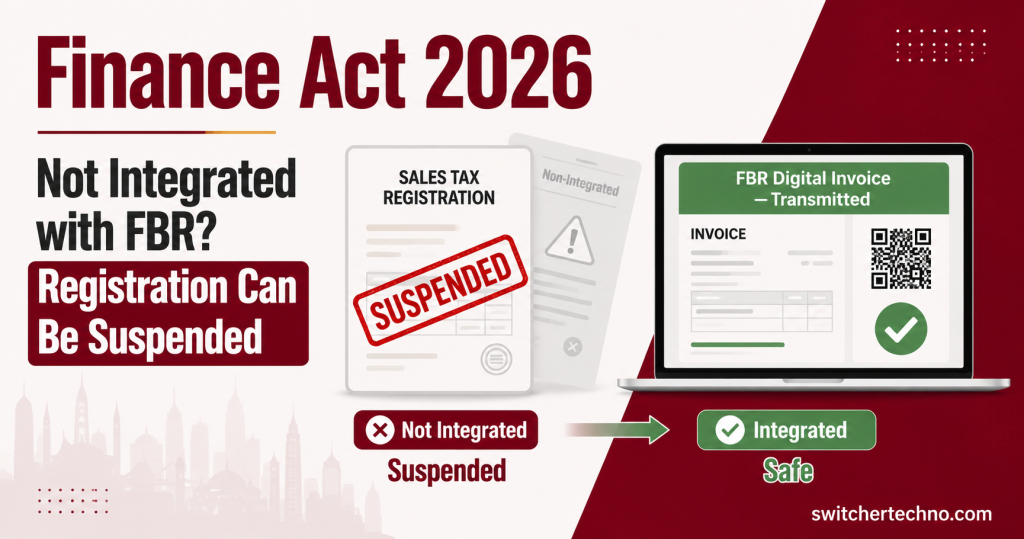
In short: Finance Act 2026, in force from 1 July 2026, gives the Commissioner Inland Revenue the power to suspend or blacklist the sales tax registration of any registered person who is not integrated with FBR’s electronic invoicing system. A suspended registration means your invoices stop carrying valid input tax for your customers, your name shows as inactive on FBR’s Active Taxpayer List, and your buyers start walking away. This article explains exactly what changed, who is at risk, what suspension does to a business in practice, and how to stay on the right side of it.
For most of 2025, the FBR digital invoicing story was about deadlines. First the corporate deadline, then the non-corporate one, then a run of extensions. Businesses that were not ready could tell themselves that another SRO would come.
Finance Act 2026 ends that phase. The question is no longer “when do I have to integrate” but “what happens to my sales tax registration if I do not”. The answer is now written into the Sales Tax Act itself, and it is not a fine you pay and move on from. It is the registration that lets you do business as a sales tax registered person.
What Finance Act 2026 actually changed
Three amendments matter for a business that is still issuing invoices outside FBR’s system.
1. Suspension and blacklisting for non-integration (Section 21)
Section 21 of the Sales Tax Act 1990 has always allowed the Commissioner to suspend or blacklist a registered person for things like fake invoices or tax fraud. Finance Act 2026 adds a new ground: non-compliance with electronic invoicing or production monitoring provisions. In plain language, if you are required to be integrated and you are not transmitting your invoices to FBR’s system, the Commissioner can suspend your registration, and in serious or repeated cases, blacklist you.
This is the first time non-integration on its own, without any allegation of fraud, is a ground for suspension.
2. Compliance-linked input tax limits
FBR can now, by notification, increase or reduce the input tax restriction for any registered person or class of registered persons based on their compliance with e-invoicing, POS integration and production monitoring. The direction of travel is clear: integrated businesses get treated better on input tax, non-integrated ones get squeezed. Combined with the existing rule that buyers cannot claim input tax on invoices from a non-integrated supplier, this puts commercial pressure on you from both sides.
3. Fake invoice register and invoice-value penalties
Finance Act 2026 also introduces a public register of persons found issuing simulated or fictitious invoices, denies input tax on purchases from such suppliers, and sets penalties equal to the value of the invoice for anti-fraud violations. This is aimed at “flying invoice” operators rather than ordinary businesses, but the practical effect touches everyone: your customers will increasingly check whether your invoice exists in FBR’s system before they accept it.
Where these powers sit: the suspension and blacklisting power is with the Commissioner under Section 21. Input tax limits are set by FBR notification. Sales tax audits and assessments will progressively move to the new National Faceless Centre, which means a mismatch between your invoices and FBR’s records is spotted by a system, not a visiting officer.
Who is actually at risk
The power applies to any sales tax registered person who is required to integrate and has not. As of mid-2026 that covers, in practice, all corporate and non-corporate registered persons under the Rule 150Q timetable, plus the sectors brought in by SRO 288(I)/2026: restaurants, hotels and marriage halls, private hospitals and clinics, diagnostic labs, private schools, gyms and clubs, beauty parlours, courier and transport operators, chartered accountancy firms and retailers.
Three profiles are most exposed:
- The “we’ll do it next quarter” business. Registered, filing returns, but still generating invoices in Excel or an old desktop package with no transmission to FBR. This is the group the amendment is written for.
- The half-integrated business. Integration was done for one outlet or one billing counter, but the second branch, the wholesale desk or the service department still issues manual invoices. FBR sees the gap between your declared turnover and your transmitted invoices.
- The business whose integration silently broke. Token expired, API credentials changed, internet went down and nobody re-transmitted. Invoices have been “issued” for weeks but never reached FBR. If you have not looked at your transmission log lately, this could be you.
What suspension does to a business in practice
Suspension is often described as a technicality. It is not. Here is what happens the day your registration is suspended.
- Your buyers lose input tax on your invoices. A suspended registration means your invoices are no longer valid for input tax adjustment. Any registered customer buying from you now pays 18% sales tax they cannot recover. Most will stop buying within days.
- Your status changes on the Active Taxpayer List. Corporate buyers, government departments and large distributors check the ATL before releasing payment. A suspended status usually means held payments and a call from their procurement team.
- Your refunds and adjustments freeze. Pending refund claims and carry-forward input tax sit in limbo until the suspension is lifted.
- Restoration takes time and paperwork. Restoring a suspended registration means completing the integration, satisfying the Commissioner that you are now compliant, and in many cases a written order. Weeks, not hours.
- Blacklisting is worse. A blacklisted person’s invoices are treated as invalid for the period, and your name becomes a red flag for every supplier and customer who does due diligence.
Do not wait for the notice. Under Section 21 the Commissioner must give you an opportunity to be heard, but the notice usually arrives after FBR’s system has already flagged the gap between your return and your transmitted invoices. By then you are explaining, not planning. Integrating before the notice is cheaper in every way.
How this interacts with the rules you already know
Finance Act 2026 does not replace the digital invoicing framework; it puts teeth into it. The rules that were already in force continue to apply:
- Every invoice for a taxable supply must be transmitted to FBR in real time through a licensed integrator or PRAL, with a unique FBR invoice number and QR code. Under Finance Act 2026 this now extends to exempt supplies and, once notified, advance receipts.
- Corrections must be made within the 72-hour window under STGO 01/2026; after that you need the Commissioner’s approval.
- If FBR’s system is down, invoices issued offline must be uploaded within 24 hours of restoration. See our guide on what to do when the FBR system is down.
- Your customers cannot claim input tax on an invoice from a non-integrated supplier. That rule, explained in our input tax adjustment risk article, is now backed by the suspension power on your side.
The one piece of good news in the same Act is the 10% tax credit under new Section 64D for money spent on integration hardware and software. If you have been putting integration off because of cost, the government is now paying a tenth of it. Details are in our post on the Finance Act 2026 tax credit for FBR digital invoicing.
What to do this week
- Check your integration status honestly. Log into your billing software and confirm that every invoice from the last 30 days shows a transmitted status with an FBR invoice number. If you cannot see that status, you are not integrated, whatever the vendor told you.
- Cover every outlet and every invoice type. Sales, returns, credit notes, exempt supplies, advance receipts. A single manual invoice book at a second branch is enough to create the gap FBR is looking for.
- Reconcile your last return against transmitted invoices. If Annex-C shows more sales than FBR’s system received, fix the transmission backlog before the next return. Our Annex-C reconciliation guide walks through the common causes.
- If you are not integrated at all, start now. Registration on IRIS, sandbox testing and go-live through a licensed integrator or PRAL typically takes a few working days with a ready-made software. See how to register for FBR digital invoicing.
- Keep the evidence. Transmission logs, error reports and re-transmission records for six years. If a notice ever arrives, this is what shows the Commissioner you acted in good faith.
To be clear about scope: software transmits your invoices and shows you what FBR has received. It does not decide suspension, lift a suspension or represent you before the Commissioner. For a notice already received, involve your tax advisor immediately and get your integration live in parallel.
Integrate before the notice, not after it
Switcher Techno’s FBR-integrated accounting, POS and ERP software transmits every invoice in real time through a licensed integrator or PRAL, shows you live transmission status for every outlet, and reconciles your Annex-C before you file. Book a free demo and we will check your current integration status with you on the call.
WhatsApp 0324-2419744 Call 0324-2419744Frequently asked questions
Yes. Finance Act 2026 amended Section 21 of the Sales Tax Act 1990 so that non-compliance with electronic invoicing or production monitoring provisions is itself a ground for the Commissioner to suspend or blacklist a registered person. No allegation of fraud is needed.
Finance Act 2026 took effect on 1 July 2026. The suspension power applies to any registered person who is required to integrate under the Sales Tax Rules (Rule 150Q and SRO 288(I)/2026) and has not done so.
Suspension is temporary: your registration is inactive until you comply and the Commissioner restores it. Blacklisting is the more serious step, usually for repeated or fraudulent conduct, and carries longer-lasting consequences for your invoices and your standing with buyers and suppliers.
Yes. Your status appears on FBR’s Active Taxpayer List, which registered buyers check before claiming input tax and, increasingly, before releasing payment. Buyers can also verify individual invoices on FBR’s online verification facility.
A small number of failed transmissions that you correct within the 72-hour window is a normal operational issue. A pattern of invoices in your return that never reached FBR is the gap the new power targets. Fix the backlog, keep the logs, and put a daily transmission check in place.
Yes. Section 64D, also introduced by Finance Act 2026, allows a tax credit of 10% of the amount invested in eligible electronic resources for FBR integration. Integrating late is still far better than a suspended registration, and the credit reduces the cost.
Section 21 is federal sales tax law. Provincial authorities have their own POS and e-invoicing integration rules and their own enforcement powers; see our guides on SRB and PRA integration. The federal suspension power discussed here applies to your FBR sales tax registration.
Related reading
- FBR Digital Invoicing 2026: complete guide
- Finance Act 2026: 10% tax credit for FBR digital invoicing
- FBR digital invoicing deadline missed? What to do now
- Non-integrated supplier = input tax loss
- Accounting and inventory software for Pakistan
This article is for general information and does not constitute tax, accounting or legal advice. The provisions of Finance Act 2026, Section 21 of the Sales Tax Act 1990 and FBR’s integration rules are subject to notification, interpretation and change. Always confirm current requirements on the official FBR website or with a qualified tax advisor before acting.
