
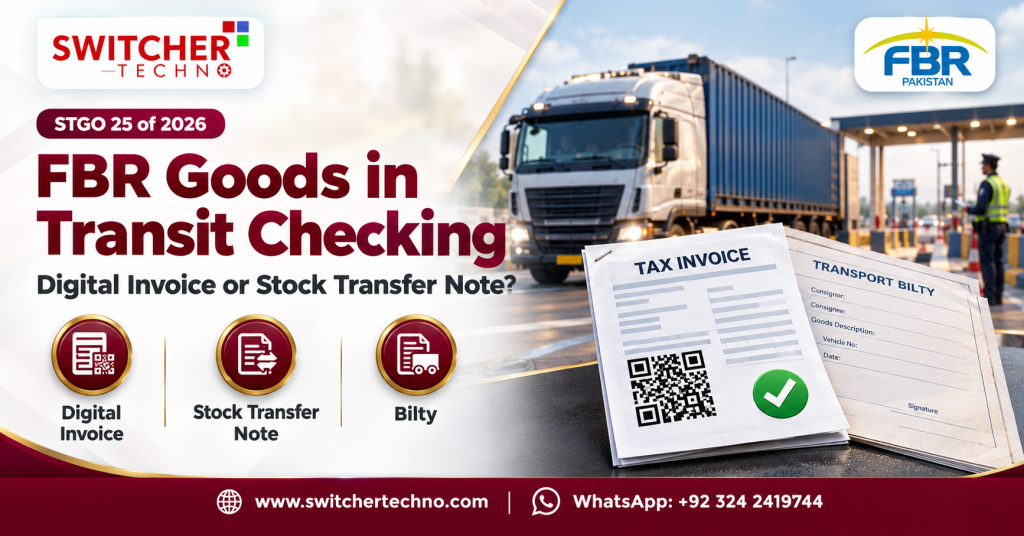
Over the past few days, notices have been circulating among transporters, importers and traders warning that FBR is checking goods vehicles on inter-city routes, and that every shipment must now travel with a digital invoice attached to the bilty. Business owners are asking three questions: Is this real? What exactly do I need to carry? And can my goods be stopped on the road?
The official answer sits in FBR’s Sales Tax General Order (STGO) No. 25 of 2026, issued on 28 September 2026. It sets out which document must travel with your goods, when a digital invoice is not needed at all, and, just as importantly, what field officers are not allowed to demand.
This guide explains it in plain language for manufacturers, distributors, importers and transporters.
Key Takeaways
- Every consignment needs one of two documents: an FBR digital invoice, or, for factory-to-own-warehouse transfers under the same STRN, a prescribed Stock Transfer Note.
- No document = “prima facie undocumented.” Consignments moving without either can face legal action under the relevant provisions.
- Officers may ask only for the digital invoice or Stock Transfer Note, not the driver’s CNIC or any other document.
- Goods in transit should not ordinarily be physically checked or unloaded. Third Schedule goods may be checked only to verify the printed retail price.
- Factory to your own warehouse (same STRN) is not a sale, so no digital invoice is needed, but the Stock Transfer Note is mandatory.
- Warehouse with a separate STRN? Then it is a taxable supply and a full digital invoice is required.
What Is Happening on the Roads?
Notices shared across transport and trade groups in early October 2026 report that FBR teams are checking goods vehicles and the cargo inside them in different cities. They advise that a digital invoice with complete details of the goods must be prepared and attached to the bilty for every shipment, and warn that goods sent without an invoice, or with incomplete documents, risk being held during checking.
FBR’s own instructions, issued a week earlier through STGO 25, point in the same direction: the right document must travel with the goods. At the same time, the order puts clear limits on what officers can do at a checkpoint, so that compliant businesses are not harassed.
What STGO 25 of 2026 Actually Says
The order is titled “Movement of Goods from Factory to Registered Person’s Own Warehouse — Non-Applicability of Digital Invoicing and Prescribed Documentation.” It is built on Section 2(33) of the Sales Tax Act, 1990: a “supply” needs a change of ownership or consideration. Moving goods between two premises of the same registered person involves neither, so it is not a taxable supply.
Here is how that plays out for the movements most businesses make every day:
| Type of Movement | Document That Must Travel With the Goods | What It Means |
|---|---|---|
| Sale or supply to a customer | FBR digital invoice (with FBR invoice number and QR code) | Issued through a licensed integrator or PRAL before dispatch |
| Factory to your own warehouse, same STRN | Stock Transfer Note marked “Stock Transfer — Not a Taxable Supply” | Not a taxable supply, so no digital invoice is required |
| Factory to a warehouse with a separate STRN | FBR digital invoice | Taxable supply: output tax applies and it must appear in your sales tax return. A Stock Transfer Note cannot replace the invoice |
| No invoice and no Stock Transfer Note | None | Treated as prima facie undocumented and liable to legal action |
What Officers Can and Cannot Ask For
This is the part of STGO 25 that most transporters have not heard about. FBR has given its field formations specific instructions on goods in transit:
| Officers CAN | Officers CANNOT |
|---|---|
| Ask for the applicable digital invoice or Stock Transfer Note | Demand the driver’s CNIC or any document other than the invoice or Stock Transfer Note |
| Check Third Schedule goods, solely to verify that the retail price is printed or embossed | Routinely subject goods in transit to physical checking, examination or unloading |
| Proceed under the law against consignments moving without either document | Divert vehicles to, or detain them at, unauthorised premises |
As reported by Business Recorder, FBR also instructed that non-issuance of a digital invoice is to be dealt with separately under the relevant provisions and will not, by itself, be grounds to detain the vehicle or goods in transit. The order closes with a clear warning: harassment of taxpayers in any form will not be tolerated, and any departure from these instructions will be viewed seriously.
The Stock Transfer Note: What It Must Contain
If you move goods from your factory to your own warehouse under the same STRN, the Stock Transfer Note is your protection at the checkpoint. Under STGO 25 it must be:
- Sequentially numbered by the dispatching unit, and prepared before dispatch
- Filled with the prescribed particulars of the goods
- Clearly endorsed “Stock Transfer — Not a Taxable Supply”
- Valued at cost only, for inventory control
- Designed so it does not resemble a tax invoice in styling or numbering
- Kept with the consignment throughout transit and produced on demand at any checkpost
On arrival, the warehouse manager acknowledges receipt and updates the warehouse stock register, and the factory updates its own records to match. In other words, the Stock Transfer Note only works if your stock records on both ends are clean.
Who Needs to Act, by Business Type
Manufacturers
You likely have both kinds of movement: sales to customers (digital invoice) and transfers to your own warehouses (Stock Transfer Note). Make sure your system can produce both, and that your dispatch staff know which one applies to which load.
Distributors and Wholesalers
Every dispatch to a retailer, sub-distributor or institutional buyer is a sale and needs a digital invoice. If your invoicing still happens at the end of the day or the week, it now needs to happen before the vehicle leaves.
Importers
Once goods are cleared and sold onward, each onward supply needs a digital invoice. FBR’s tighter scrutiny of importers is already visible. Read our breakdown of the FBR crackdown on importers and green channel removal.
Transporters and Goods Forwarding Agencies
You do not issue the invoice, but it is your vehicle that gets stopped. Make it booking policy: no load without a copy of the digital invoice or Stock Transfer Note, and record the invoice number on the bilty. This protects your drivers, your schedule and your relationship with the consignor.
Buyers
Before accepting a consignment, check that the invoice is genuine by scanning the QR code. Here is how to verify an FBR invoice QR code. Buying from a non-integrated supplier can also cost you your input tax claim. See why a non-integrated supplier can mean input tax loss.
A Simple Dispatch Checklist
- Issue the document before loading. Digital invoice for a sale, Stock Transfer Note for a same-STRN transfer to your own warehouse.
- Print it clearly, with the FBR invoice number and QR code readable.
- Attach it to the bilty and write the invoice or Stock Transfer Note number on the bilty itself.
- Send a PDF or photo to the driver’s phone as a backup copy.
- Match the paperwork to the load. Item descriptions and quantities on the invoice must match what is actually on the vehicle.
- Keep a dispatch register with invoice number, bilty number, vehicle number and date, so any query can be answered in minutes.
- Plan for system downtime. If the FBR system is down at dispatch time, follow the offline invoicing procedure. See FBR system down: offline invoicing and the 24-hour rule.
Every Dispatch Needs a Digital Invoice. Make It Automatic.
Switcher Techno’s FBR-integrated billing, POS and ERP software issues digital invoices with FBR invoice number and QR code at the moment of dispatch, with stock movement tracked in the same system. Manufacturers, distributors and importers across Pakistan use it to keep every load documented.
Book a Free Demo WhatsApp: +92 324 2419744What Is Coming Next: e-Bilty and Cargo Tracking
Roadside checking is only the first step. In March 2026, FBR began work on a cargo tracking and e-Bilty mechanism, an electronic transport waybill carrying an instantly verifiable QR code and linked to FBR’s real-time invoice verification system. The project is financed under a World Bank programme and was in its design phase at launch, with full implementation planned over a period of up to three years.
The direction is clear: in the coming years, the bilty and the invoice will be matched electronically rather than by an officer reading paper at the roadside. Businesses whose invoicing is already integrated with FBR will move to that system with little effort. Those still issuing manual invoices will have to change twice.
If you are not yet integrated, start with our complete FBR digital invoicing guide for 2026 and the step-by-step guide on how to integrate your business with FBR digital invoicing.
The Bottom Line
STGO 25 of 2026 is good news for compliant businesses: officers can ask for one document, and nothing more. But it is bad news for anyone still moving goods without paperwork, because the rule is now simple and visible at every checkpoint: digital invoice or Stock Transfer Note, every load, every time.
The fastest way to stay on the right side of that rule is to stop treating invoicing as back-office paperwork and make it part of dispatch. That means the invoice is generated, printed and attached before the vehicle moves.
Frequently Asked Questions
Is FBR really checking goods vehicles on highways?
Notices circulating among transporters and traders in October 2026 report checking of goods vehicles in different cities. Officially, FBR’s STGO No. 25 of 2026, issued on 28 September 2026, sets out which documents must accompany goods in transit and what field officers may and may not demand.
What document must travel with my shipment?
For any sale or supply, an FBR digital invoice. For moving goods from your factory to your own warehouse under the same STRN, a prescribed Stock Transfer Note endorsed “Stock Transfer — Not a Taxable Supply.” If the receiving warehouse has a separate STRN, a digital invoice is required.
Do I need a digital invoice to move goods from my factory to my own warehouse?
Not if both premises are under the same STRN. Under Section 2(33) of the Sales Tax Act, 1990, this is not a taxable supply. You must, however, carry a sequentially numbered Stock Transfer Note with the goods and produce it on demand.
Can an FBR officer ask for the driver’s CNIC?
No. Under STGO 25 of 2026, officers will not demand the driver’s CNIC or any document other than the applicable digital invoice or Stock Transfer Note.
Can my goods be seized if there is no digital invoice?
A consignment moving without either a digital invoice or a Stock Transfer Note is treated as prima facie undocumented and can face legal action under the relevant provisions. FBR has also instructed that non-issuance of a digital invoice will not, by itself, be grounds to detain the vehicle or goods in transit. The safest course is never to dispatch without the correct document.
Can officers unload or physically check my goods?
Goods in transit should not ordinarily be physically checked, examined or unloaded. Goods listed in the Third Schedule to the Sales Tax Act may be checked solely to verify that the required retail price is printed or embossed on them.
Are transporters responsible for issuing the digital invoice?
No. The supplier or consignor issues the digital invoice or Stock Transfer Note. But since the vehicle is what gets checked, transporters should insist on a copy of the correct document before accepting any load and record its number on the bilty.
Is Switcher Techno a licensed integrator?
No. Switcher Techno provides FBR-ready POS, ERP and accounting software and integration services, and connects your system to FBR’s platform through the proper licensed channel — a licensed integrator or PRAL. We do not claim to be an FBR-certified or PRAL-certified integrator.
This article is provided for general information only and does not constitute tax, legal or professional advice. It is based on STGO No. 25 of 2026 as reported in the press at the time of writing. FBR rules and procedures change frequently. Always verify your specific position on the official FBR portal or with a qualified tax advisor before acting. Switcher Techno is not an FBR-certified or PRAL-certified integrator; integration is carried out through a licensed integrator or PRAL.
