
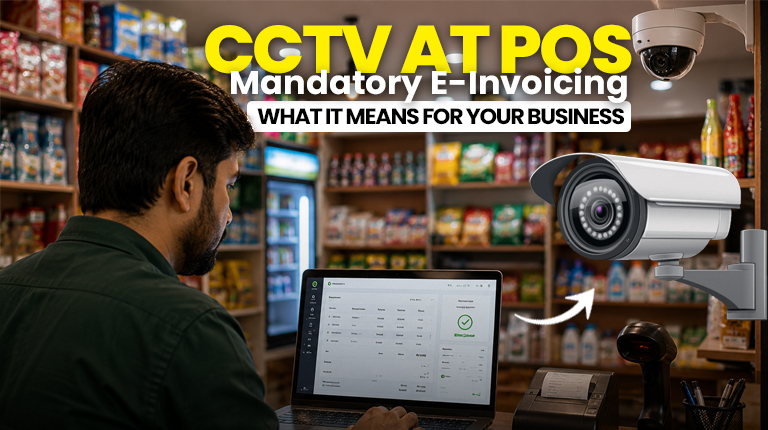
The FBR draft rules 2026, issued as SRO 288(I)/2026, are one of the biggest changes Pakistani businesses have faced in years. Under these proposed rules, the Federal Board of Revenue can require notified businesses to connect their point-of-sale to FBR’s system, issue real-time QR-coded invoices — and, in a first for Pakistan, install CCTV cameras at every point of sale. If your business is on the notified list, this affects how you bill every single customer. This guide breaks down what the rules say, who is affected, the CCTV requirement, the penalties, and how to get compliant without disrupting your operations.

These amendments replace the old Chapter VIIA of the Income Tax Rules, 2002 with a far stricter framework. They are still in draft form and open to feedback, but the direction is clear: FBR wants every notified sale documented digitally and verifiable in real time.

What is SRO 288(I)/2026?

SRO 288(I)/2026, dated 18 February 2026, is a draft notification under the Income Tax Ordinance, 2001. It introduces a new chapter titled “Online Integration of Businesses” and brings in fresh rules covering electronic invoicing, POS integration, QR codes, real-time sales reporting, a licensing system for integrators, CCTV requirements, and penalties for non-compliance.

In simple terms: businesses on the notified list must link their billing system to FBR, so each sale is reported live with a verifiable receipt — before the transaction is even completed.

Which businesses are affected?

The draft rules cast a wide net. Unlike earlier sales-tax-only rules, these income-tax rules pull in many service businesses for the first time. Notified categories include:

  • Hospitality: restaurants, hotels, guest houses, hostels, motels, marriage halls and marquees
  • Clubs: including well-known clubs such as Karachi Gymkhana, Lahore Gymkhana and the Polo Club Islamabad
  • Personal care & medical: beauty parlours, slimming centres, hair transplant clinics, private clinics, dental clinics, plastic surgeons, physiotherapists, veterinary doctors and pathological laboratories
  • Transport & logistics: inter-city road transport, courier and cargo services
  • Professionals: chartered accounting firms, cost & management accounting firms
  • Education: private institutions charging fees of at least Rs1,000 per month
  • Retailers & online sellers: including websites and mobile apps

Some very small retailers — for example those with low electricity consumption or minimal fees — may be exempt. But if your business appears on the schedule, compliance is mandatory.

The CCTV at POS rule — what you need to know

This is the headline change. Under the draft rules, FBR may require integrated businesses to install CCTV cameras at each point of sale and retain the recordings for at least one month. These recordings must be produced before the Commissioner when demanded.

The purpose is enforcement: FBR wants to be able to match physical sales activity against the invoices reported to its system. For business owners, it means the cost of cameras and storage — like the rest of the integration cost — will be borne by you, the taxpayer.

What every invoice must now contain

The draft rules standardise invoicing tightly. Under SRO 288, every invoice from an integrated business must:

  • Carry a unique FBR invoice number obtained before the sale is completed
  • Display a verifiable QR code (7×7 mm)
  • Contain up to 26 mandatory fields — including seller and buyer details, tax amounts, HS code and a digital signature
  • Be transmitted to FBR in real time

Offline sales (during internet outages) must be uploaded within 24 hours of the connection being restored. And every outlet must display an “Integrated with FBR” signboard with the FBR logo. FBR may also require businesses to connect their card machines and digital payment systems to its network.

Penalties for non-compliance

The draft rules give FBR strong enforcement powers. Businesses that make sales without integrated invoicing, tamper with the system, or otherwise violate SRO 288 can face penalty action under Section 182 of the Income Tax Ordinance, along with possible business restrictions. FBR plans to deploy Inland Revenue Enforcement squads to patrol premises and verify real-time compliance — and where QR-coded invoices or FBR invoice numbers are missing, officers may estimate unaccounted sales and recover tax with penalties.

Who can legally integrate your business?

The draft introduces a formal licensing regime for software providers and integrators. No entity may integrate a business with FBR’s system without a five-year, non-transferable license from the Board. PRAL (Pakistan Revenue Automation Limited) is authorised to act as a licensed integrator and may provide free integration on demand.

Importantly, your billing or POS software can be any compliant solution — but the final connection to FBR is made through a licensed integrator. This is why choosing the right, integration-ready POS or accounting system early makes the whole process smoother.

Is this final? Should you act now?

The rules are still a draft and were opened for public feedback, with stakeholders given a short window to submit objections. Some Provincial Revenue Authorities (such as the SRB and Balochistan Revenue Authority) have raised concerns about duplication, since several listed services already integrate with provincial systems. So details may change before the final Gazette notification.

That said, the broader direction — real-time digital documentation of every sale — is firmly set. Smart business owners are preparing their systems now, so that whenever the rules are finalised, going live is a quick switch rather than a scramble under enforcement pressure.

How Switcher Techno can help

Switcher Techno provides FBR POS integration and digital invoicing services for businesses across Pakistan. We help you set up an integration-ready POS or ERP, generate compliant invoices with unique FBR numbers and QR codes, and connect to FBR’s system through the proper licensed channel — so you can stay compliant without disrupting your daily operations. Whether you run a restaurant, clinic, salon, retail outlet or a multi-branch business, we make the transition smooth.

For a detailed technical breakdown of the rules, also read our guide on SRO 288(I)/2026 and FBR online integration.

Frequently Asked Questions

Find answers to commonly asked questions about FBR Digital Invoicing.