
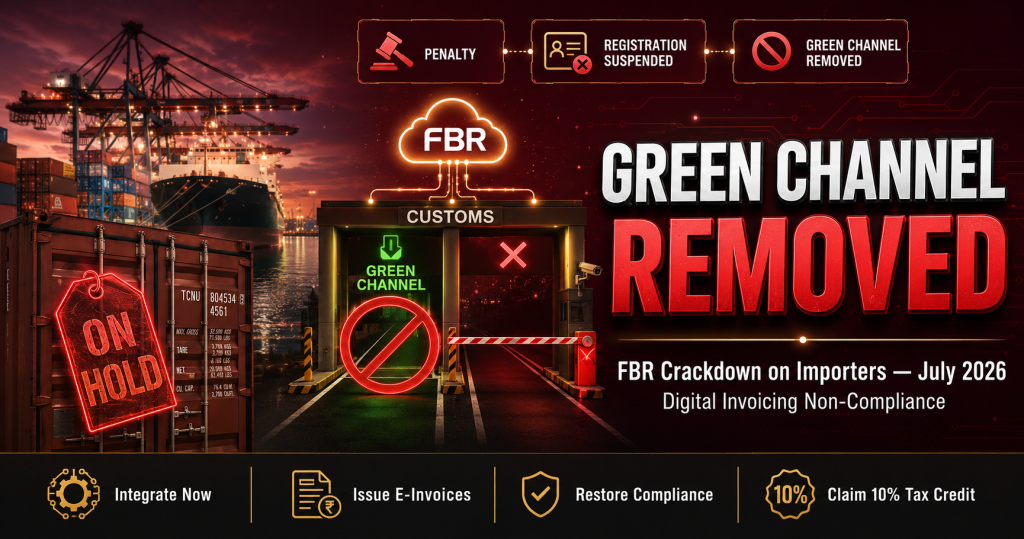
The FBR has begun its toughest enforcement action yet on digital invoicing. From 1 July 2026, importers who have not integrated with the Digital Invoicing System face penalty proceedings, suspension of sales tax registration — and removal from the green channel at the import stage. For an importer, losing green channel means every shipment goes into physical inspection: delays, demurrage, and rising costs on every consignment. Here is who is affected, what exactly FBR is doing, and how to fix your compliance before it hits your imports.
Key Takeaways
- From 1 July 2026, FBR is taking punitive action against importers who have not complied with the Digital Invoicing System.
- The actions include penalty proceedings, suspension of sales tax registration, and removal from the green channel at import stage.
- Importers were required to integrate by 25 October 2025 and issue all invoices through the system from 1 November 2025 under SRO 1852(I)/2025 — enforcement is now catching up with non-compliance.
- Green channel removal means physical examination of consignments — slower clearance, port charges, and disrupted supply chains.
- The fix is straightforward: complete registration, integrate through a licensed integrator, and start issuing electronic invoices — before your next shipment arrives.
What has FBR announced for importers?
FBR has taken notice of the slow pace of registration, integration, and issuance of electronic invoices by importers under the Digital Invoicing regime, and is treating the matter as a priority under its Transformation Plan. From 1 July 2026, the enforcement measures against non-compliant importers include:
- Initiation of penalty proceedings under the Sales Tax Act, 1990
- Suspension of sales tax registration — which invalidates your ability to issue tax invoices and damages your buyers’ input tax claims
- Removal from the green channel at the import stage, until Digital Invoicing compliance is completed
This is not a new deadline — it is enforcement of an old one. Under SRO 1852(I)/2025, importers had to integrate with the Digital Invoicing System by 25 October 2025 and issue all invoices through it from 1 November 2025. Many did not. That grace period is now over.
What is the green channel — and why does losing it hurt so much?
Pakistan Customs clears imports through a risk management system that assigns consignments to channels. The green channel is the fastest: your goods are cleared without physical examination or document scrutiny, based on your compliance profile. It is what keeps a serious importer’s supply chain moving.
Removal from green channel pushes your consignments into scrutiny — document checks and physical examination. In practical terms, that means:
- Clearance delays on every shipment — days instead of hours
- Demurrage and detention charges at ports and terminals piling up while goods sit
- Unpredictable supply chain — you can no longer commit delivery dates to your customers
- Higher handling costs and repeated interaction with customs staff on each consignment
Enforcement actions at a glance
| Enforcement action | What it means for your business |
|---|---|
| Penalty proceedings | Monetary penalties under the Sales Tax Act — from Rs 500,000 up to Rs 3,000,000 for repeated violations |
| Suspension of sales tax registration | Your tax invoices become invalid, buyers lose input tax adjustment, and compliant customers stop dealing with you |
| Green channel removal | Every consignment faces scrutiny/physical examination — delays, demurrage, and disrupted deliveries until you comply |
Suspension powers have also been reinforced at the legislative level — the Finance Act 2026 expressly empowers the Commissioner to suspend or blacklist registered persons for e-invoicing non-compliance. On the flip side, the same Act introduced a 10% tax credit on your FBR integration investment — so the cost of fixing this is now partially refunded through the tax system.
Who exactly is affected?
Every importer registered for sales tax falls under the Digital Invoicing mandate — importers were in the very first integration phase under SRO 1852(I)/2025, alongside public companies and large taxpayers. You are exposed to this enforcement if any of these apply:
- You have not registered for Digital Invoicing on the FBR portal at all
- You registered but never completed integration through a licensed integrator
- You integrated but are not actually issuing electronic invoices for your supplies
That last category matters: FBR’s concern is not just registration numbers but live invoices flowing through the system. An integration that sits unused is still non-compliance.
How to restore or protect your compliance: 5 steps
- Check your actual status todayConfirm three things: are you registered for Digital Invoicing, is your system integrated, and are electronic invoices actually being issued for every supply? Many importers assume they are compliant when only step one was done.
- Register on the FBR portalIf not yet registered, complete Digital Invoicing registration through IRIS first — everything else depends on it.
- Integrate through a licensed integratorConnect your ERP, POS, or invoicing software to FBR’s system through a licensed integrator. Since STGO 01 of 2026, you can even engage more than one integrator. Sandbox testing comes first, then production go-live.
- Start issuing electronic invoices immediatelyEvery taxable supply must generate a real-time invoice with an FBR invoice number and QR code. Remember the 72-hour correction window — errors must be fixed fast, so train your billing team.
- Regularize past non-complianceIf proceedings have already started or your registration has been suspended, complete integration first, then approach your Commissioner/RTO with proof of compliance to restore your registration and green channel status. Involve your tax advisor.
The bigger picture: enforcement is only going one way
This importer crackdown is not an isolated step. FBR expects all active sales tax filers on the Digital Invoicing System, has rolled out a public invoice verification facility so buyers can check any invoice against FBR’s system, and has expanded integration to service businesses through the SRO 288(I)/2026 framework. Enforcement capacity — auditors, risk management systems, production tracking — keeps growing.
The pattern is clear: first a deadline, then a grace period, then enforcement that hurts operations, not just wallets. Importers are feeling it now; other categories are next. If you are still not integrated, the cheapest day to fix it is today. Start with our complete FBR digital invoicing guide to understand the full picture.
Restore Your Compliance Before Your Next Shipment
Switcher Techno provides FBR digital invoicing integration services for importers and businesses across Pakistan — registration, integration through a licensed integrator, sandbox testing, and go-live. Get compliant fast, keep your green channel, and claim your 10% tax credit.
Book a Free DemoFrequently Asked Questions
What action is FBR taking against non-compliant importers?
From 1 July 2026, FBR is pursuing penalty proceedings, suspension of sales tax registration, and removal from the green channel at the import stage against importers who have not complied with the Digital Invoicing System.
What was the original digital invoicing deadline for importers?
Under SRO 1852(I)/2025, importers were required to integrate with the Digital Invoicing System by 25 October 2025 and issue all invoices through the system from 1 November 2025.
What does removal from the green channel mean?
Your import consignments lose fast-track clearance and are routed into scrutiny and physical examination — causing clearance delays, demurrage and detention charges, and supply chain disruption until Digital Invoicing compliance is completed.
How do I get my green channel status back?
Complete your Digital Invoicing compliance — registration, integration through a licensed integrator, and live issuance of electronic invoices — and then approach your Commissioner/RTO with proof of compliance to restore your registration and channel status.
I am integrated but not issuing e-invoices — am I safe?
No. FBR’s concern covers registration, integration, and actual issuance of electronic invoices. An integration that is not generating live invoices for your supplies still counts as non-compliance.
Is there any incentive for completing integration now?
Yes. The Finance Act 2026 introduced a 10% tax credit under Section 64D on eligible investment in FBR integration hardware and software, claimable in the tax year the system is installed, integrated, and fully configured.
Disclaimer: This article is for informational purposes only and should not be considered legal or tax advice. Enforcement procedures and deadlines can change. Always confirm your status and obligations with the official FBR portal and a qualified tax advisor.
