
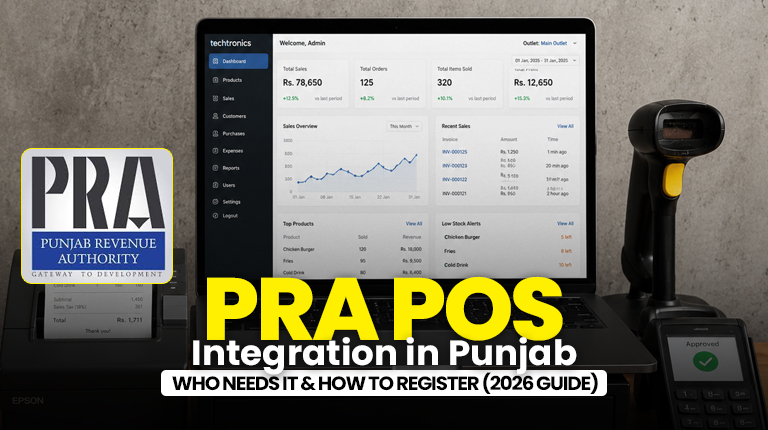
PRA POS integration connects your point-of-sale system directly to the Punjab Revenue Authority (PRA) so your sales are reported in real time, with a QR-coded invoice customers can verify. For restaurants, salons, and many service businesses in Punjab, this integration is mandatory under the Punjab Sales Tax on Services Act 2012 — and non-compliance can lead to notices, penalties, and legal action. This guide explains who needs it, the step-by-step process, monthly filing, and how to get compliant without disrupting your business.

The PRA is the provincial body that collects sales tax on services rendered within Punjab. As enforcement tightens — especially for food businesses — integrating your POS early is far simpler and cheaper than dealing with a compliance notice later.

What is PRA POS integration?

PRA POS integration is an online, real-time system that connects your computerized sales system to the Punjab Revenue Authority through the internet. Every time you make a sale, the transaction is reported to PRA automatically, and a barcode or QR code is printed on the invoice. Customers can verify the sales tax through the PRA Tax App, while the system also helps you prepare your sales tax returns automatically.

In short, the moment a bill is generated, it is documented with PRA — no manual filing, no separate paperwork, and a verifiable record for both you and your customers.

Who needs PRA POS integration in Punjab?

PRA registration and POS integration are required for service businesses operating in Punjab. You likely need it if you run:

  • Restaurants, cafes, and bakeries — all food outlets in Punjab must register with PRA
  • Prepare your documents — CNIC or NTN, proof of business address, bank details, and business registration if applicable.
  • Integrate your POS with PRA’s system through a service provider.
  • Test and verify that invoices are accepted and QR codes print correctly.
  • Go live — each sale is reported to PRA in real time, with a verifiable invoice and QR code.

Some very small retailers — for example those with low electricity consumption or minimal fees — may be exempt. But if your business appears on the schedule, compliance is mandatory.

The CCTV at POS rule — what you need to know

This is the headline change. Under the draft rules, FBR may require integrated businesses to install CCTV cameras at each point of sale and retain the recordings for at least one month. These recordings must be produced before the Commissioner when demanded.

The purpose is enforcement: FBR wants to be able to match physical sales activity against the invoices reported to its system. For business owners, it means the cost of cameras and storage — like the rest of the integration cost — will be borne by you, the taxpayer.

What every invoice must now contain

The draft rules standardise invoicing tightly. Under SRO 288, every invoice from an integrated business must:

  • Carry a unique FBR invoice number obtained before the sale is completed
  • Display a verifiable QR code (7×7 mm)
  • Contain up to 26 mandatory fields — including seller and buyer details, tax amounts, HS code and a digital signature
  • Be transmitted to FBR in real time

Once live, your team bills exactly as before — PRA reporting happens in the background on every sale. The same POS can also handle other tax bodies, so if you operate across provinces, you can stay compliant with FBR and SRB too. For Federal POS compliance, see our FBR POS integration services.

PRA monthly filing and compliance

PRA requires monthly filing of sales tax returns. Businesses must file their returns by the 15th of the following month to report taxable services and deposit the tax collected. With PRA POS integration, much of this is automated — your sales data is already documented, making return preparation faster and reducing the risk of errors or missed deadlines.

What happens if you don’t integrate with PRA?

Failure to register and integrate with PRA, when required, can result in penalties, fines, and possible legal action. Operating without PRA registration can also create tax liabilities and block access to formal market opportunities in Punjab — and for food businesses, it prevents you from getting a PFA license. With enforcement strengthening under Punjab government directives, early compliance is the safer and cheaper path.

How Switcher Techno can help

Switcher Techno provides PRA POS integration services for restaurants, salons, and service businesses across Punjab. We connect your existing POS to PRA, generate compliant invoices with QR codes, and help you stay on top of monthly filing — all without disrupting your daily operations. Our system also supports FBR and SRB compliance, so multi-province businesses can manage everything in one place. Whether you run a single outlet or several branches, we help you get compliant before any notice arrives.

Frequently Asked Questions

Find answers to commonly asked questions about FBR Digital Invoicing.