
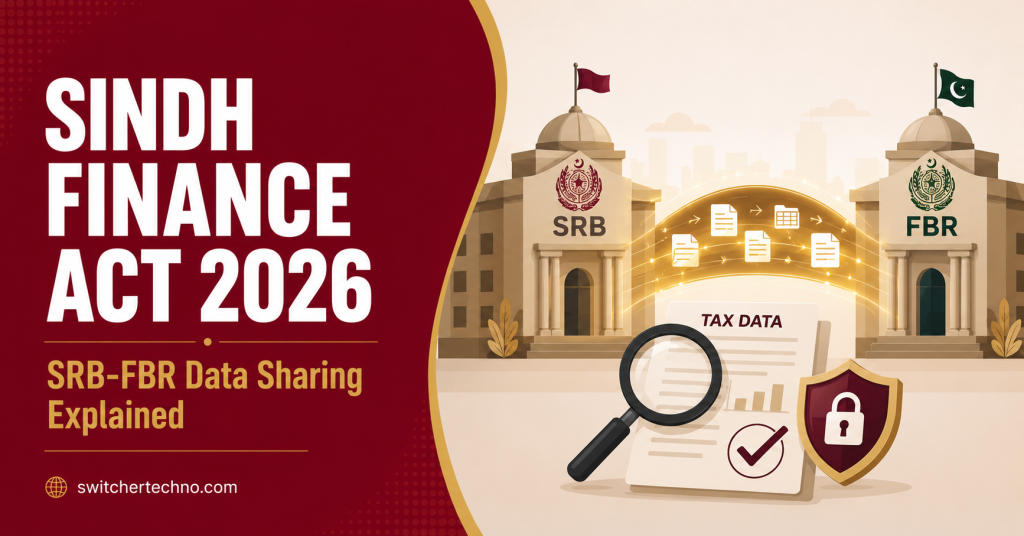
Sindh Finance Act 2026: SRB–FBR Data Sharing Is Here — What Changed for Service Businesses From July 1
Quick answer: The Sindh Finance Act, 2026 (Sindh Act No. XX of 2026) took effect on July 1, 2026. The most consequential change for businesses is the new Section 73A of the Sindh Sales Tax on Services Act, which gives SRB a formal legal framework to share taxpayer information with federal and provincial authorities — including under bilateral agreements with other tax bodies. In plain terms: the wall between your FBR record and your SRB record is coming down. A business declaring healthy income to FBR while staying unregistered (or under-declaring) with SRB is now exposed to formal cross-matching. Combined with SRB’s record Rs370 billion collection last year and its stated FY27 focus on broadening the tax base and digital transformation, Sindh’s service businesses should treat this as the start of a stricter enforcement cycle.
What Is the Sindh Finance Act 2026?
Each year, the Sindh Finance Act amends the province’s tax laws — most importantly the Sindh Sales Tax on Services Act, 2011, administered by the Sindh Revenue Board (SRB). The 2026 Act was passed by the Sindh Assembly and is effective from July 1, 2026, applying to the new fiscal year 2026-27. While the headline sales tax structure continues from last year’s overhaul, the 2026 Act’s standout addition is procedural — and arguably more powerful than any rate change: a formal information-sharing regime.
Section 73A: The End of the FBR–SRB Wall
The new Section 73A addresses disclosure of taxpayer information. It protects the confidentiality of taxpayer records as a general rule, but creates clear legal exceptions allowing SRB to share information with:
- Officials engaged in administering and enforcing the Sindh Sales Tax on Services Act, where access is necessary for official duties;
- Departments and authorities of the Federal Government and provincial governments that are legally authorised to access such information;
- Other government departments or authorities under bilateral or multilateral agreements entered into by SRB, for enforcing the taxes, duties, or levies those bodies administer.
Why does this matter so much? Because the biggest gap in Pakistan’s tax enforcement has always been fragmentation: FBR sees your income tax and (for goods) your sales tax; SRB sees your services tax; and historically, the two datasets rarely talked to each other formally. Section 73A provides the legal plumbing for that conversation. A services business whose FBR income tax return shows Rs50 million in revenue, but which has no SRB registration — or declares a fraction of that as taxable services — is now a query away from discovery.
Recap: The Regime This Act Builds On
The 2026 Act lands on top of last year’s structural overhaul, which many Sindh businesses still haven’t fully absorbed:
| Element | Position in FY 2026-27 |
|---|---|
| Scope of taxation | Negative list regime — all services provided in Sindh are taxable unless specifically exempted, replacing the old positive list |
| Definition of “service” | Expansive — any activity, facility, utility, or advantage, including assignment of rights |
| Standard rate | 15% |
| Higher rate (19.5%) | Telephony, internet, hosting and IT infrastructure, security systems, and similar notified services |
| Reduced rates (3%–8%) | Eligible sectors including construction, freight transport, call centres, IT support, and hospitality |
| Service classification | UN Central Product Classification (CPC) codes — standardized registration and return categories |
If your business assumed it was outside the net because it wasn’t “on the list” — that list no longer exists. Under the negative list regime, the default answer to “is my service taxable in Sindh?” is yes, unless specifically exempt.
Why Enforcement Will Intensify in FY27
SRB closed FY 2025-26 with its highest-ever collection — Rs370.064 billion, beating its Rs362 billion target, with Sindh Sales Tax alone growing 21.2% to Rs344.6 billion and June 2026 setting an all-time monthly record of Rs45.08 billion. Announcing those numbers, SRB explicitly stated its FY27 agenda: broadening the tax base, enhancing voluntary compliance, and accelerating digital transformation in tax administration.
Read those three phrases as a business owner and the translation is simple: more registrations (new sectors receiving notices — as gyms and fitness centers are already experiencing; see our SRB guide for gyms), more data-driven audits (Section 73A is the enabler), and more electronic verification of invoices and returns. SRB’s TRIMS system already automates show-cause notices and recovery tracking — the data-sharing law gives it far more raw material to work with.
What Should Sindh Service Businesses Do Now?
- Check your registration status honestly. Under the negative list, if you provide services in Sindh in the course of economic activity, assume you’re in scope unless a specific exemption covers you — and verify that with a consultant, not a guess.
- Reconcile your FBR and SRB pictures. Your declared services revenue with SRB should be consistent with your FBR income tax filings and your banking reality. Inconsistencies that were invisible last year are discoverable this year.
- Fix your invoicing. Every service invoice should carry the proper tax breakup and feed into a record you can produce on demand. Businesses using SRB-integrated billing software generate compliant invoices automatically and keep monthly summaries return-ready.
- File every month, on time. Under the negative list regime with data sharing in force, a missed return is no longer a quiet lapse — it’s a flag.
- Keep one system of record. When sales, receipts, and taxes live in one accounting software instead of diaries and spreadsheets, cross-matching holds no fear — your FBR story and your SRB story are the same story, because they come from the same books.
One System. One Truth. Zero Cross-Matching Fear.
Switcher Techno’s accounting software with built-in SRB integration keeps your service billing, tax breakups, and monthly summaries consistent and return-ready — so whether SRB looks, FBR looks, or both compare notes under Section 73A, your records tell one clean story.
Explore SRB Integration →Frequently Asked Questions
When did the Sindh Finance Act 2026 come into effect?
The Sindh Finance Act, 2026 (Sindh Act No. XX of 2026) is effective from July 1, 2026, applying to fiscal year 2026-27.
What is Section 73A of the Sindh Sales Tax on Services Act?
Section 73A is a new provision on disclosure of taxpayer information. It protects confidentiality as a general rule while allowing SRB to share taxpayer information with authorised officials, federal and provincial government authorities, and other tax bodies under bilateral or multilateral agreements for tax enforcement purposes.
Does this mean FBR can see my SRB data?
The provision creates a legal framework for information exchange between SRB and other legally authorised authorities, including federal bodies. Practically, businesses should assume their declared figures across FBR and SRB can be compared, and keep them consistent.
Are all services in Sindh now taxable?
Sindh operates a negative list regime: all services provided in the province in the course of economic activity are taxable unless specifically exempted. The standard rate is 15%, with higher (19.5%) and reduced (3%–8%) rates for notified categories.
How can my business prepare for increased SRB enforcement?
Verify your registration status, reconcile your SRB declarations with your FBR filings and bank records, issue proper tax invoices, file monthly returns on time, and maintain a single system of record — ideally accounting software with SRB-compliant invoicing built in.
Disclaimer: This article is for informational purposes only and should not be considered legal or tax advice. Provisions of the Sindh Finance Act 2026 and SRB rules are subject to official interpretation and change. For your business’s specific obligations, refer to the Sindh Revenue Board’s official website (srb.gos.pk) or consult a licensed tax advisor.
