
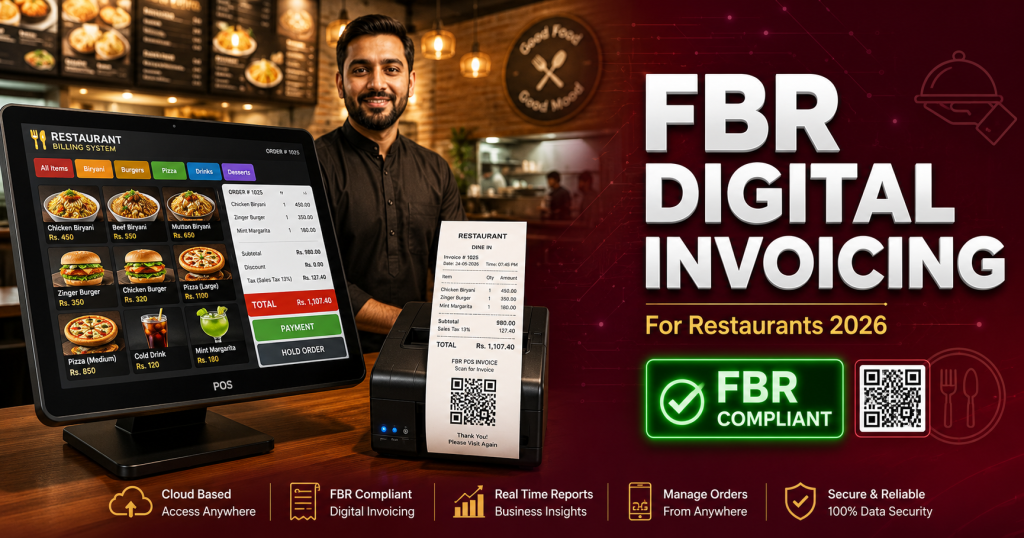
FBR’s digital invoicing net is expanding fast — and restaurants, cafes, and hotels are now firmly inside it. If you run a food business in Pakistan, every bill you print may soon need to carry a unique FBR invoice number and a QR code, reported to FBR in real time. This guide explains exactly what FBR digital invoicing means for restaurants, how to become compliant, and how to do it without slowing down your counter.
Does FBR digital invoicing apply to restaurants?
Yes. FBR has been widening the scope of digital invoicing to cover notified service businesses — and restaurants, cafes, and hotels are on that list. As a sales-tax-registered food business, you are expected to generate each bill electronically and transmit it to FBR’s system in real time, so every customer receipt carries a verifiable QR code. The exact go-live date depends on your category and turnover, so the safest approach is to prepare early rather than wait for a notice.
Key takeaways
- Restaurants are in scope: Food businesses are among FBR’s notified service categories.
- Every bill counts: Each receipt needs a unique FBR number and a QR code.
- Real-time reporting: Sales are transmitted to FBR at the moment of billing.
- Integration through PRAL: Done via a licensed integrator or PRAL — free of FBR fee.
- Right POS matters: A restaurant POS built for FBR keeps your counter fast and compliant.
Why restaurants are a special case
A restaurant is not a simple retail shop. You deal with dine-in, takeaway, and delivery; split bills; table-wise orders; service charges; and a rush of transactions at peak hours. Digital invoicing has to work with that speed, not against it. If your billing system pauses or fails during a Friday-night rush because it can’t reach FBR, that’s lost customers and chaos at the counter. This is exactly why choosing the right restaurant POS — one designed for FBR integration and offline handling — matters more for food businesses than for most other sectors.
What a compliant restaurant bill must include
Under FBR’s digital invoicing rules, a compliant receipt is more than a printed total. Each bill your restaurant issues must carry:
- A unique FBR invoice number generated through the integrated system.
- A verifiable QR code the customer can scan to confirm the bill is genuine.
- Complete details — your restaurant’s name and tax number, items, quantities, tax rate, and total.
- Real-time transmission to FBR at the moment the bill is generated.
Reality check: Customers are increasingly checking receipts for the FBR QR code, and FBR has run campaigns rewarding those who verify their invoices. A restaurant that can’t issue a verifiable bill risks penalties and a dent in customer trust — while compliant outlets look more professional and transparent.
How to handle internet outages at the counter
This is the biggest worry for restaurant owners — what happens when the internet drops mid-rush? FBR’s framework accounts for this. If your connection or FBR’s system is temporarily down, bills issued during that period are marked as offline mode and uploaded to FBR once the connection is restored, within the allowed window. A good restaurant POS handles this automatically — it keeps billing customers without interruption and syncs with FBR the moment the internet is back, so your counter never stops.
Tip: When choosing a restaurant POS, specifically ask how it behaves during an internet outage. If it can keep taking orders offline and auto-sync to FBR later, your peak-hour service stays smooth and compliant.
Steps for a restaurant to become FBR-compliant
Getting your food business compliant is straightforward if you follow the right order:
- Confirm your status and deadlineCheck whether your restaurant is in a notified category and identify your integration deadline based on your sales tax record.
- Register on the FBR IRIS portalComplete your business and outlet registration on FBR’s system if you haven’t already.
- Choose an FBR-ready restaurant POSPick a POS built for restaurants that supports real-time FBR invoicing, QR codes, and offline handling.
- Integrate through a licensed integrator or PRALConnect your POS to FBR’s system. PRAL provides integration free of cost, and FBR charges no fee for the system itself.
- Test, then go liveRun trial bills in the sandbox to catch errors, then switch on live invoicing so every receipt carries a QR code.
What FBR digital invoicing costs a restaurant
Many restaurant owners assume compliance is expensive. In reality, FBR does not charge a fee for the system, and PRAL provides integration free of cost. Your real cost is the restaurant POS software that connects your billing to FBR and the integrator’s configuration fee, which FBR caps. Compared to the penalties for non-compliance, and the daily benefit of clean, automated records, it’s a small and worthwhile investment.
| Concern | Without FBR-ready POS | With FBR-ready restaurant POS |
|---|---|---|
| Compliant billing | Manual, error-prone | Automatic QR-coded bills |
| Peak-hour speed | Slows or stops | Fast, uninterrupted |
| Internet outage | Billing breaks | Offline mode + auto-sync |
| Penalty risk | High | Protected |
| Records & reports | Scattered | Clean, ready for filing |
How Switcher Techno can help
Switcher Techno offers a cloud-based Restaurant POS built for Pakistani food businesses — with dine-in, takeaway, and delivery billing, table management, kitchen orders, and full FBR digital invoicing integration. Every bill prints a unique FBR invoice number and QR code, reported to FBR in real time, and our offline handling keeps your counter running even if the internet drops. Explore our POS software that connects billing, inventory, and accounting in one place. Still tracking sales in registers or spreadsheets? See why businesses are switching from Excel to cloud accounting in 2026.
Make your restaurant FBR-ready
Issue QR-coded, FBR-compliant bills on every order — without slowing down your counter. Book a free demo today.
Book a Free DemoFrequently Asked Questions (FAQs)
Do restaurants need FBR digital invoicing?
Yes. Restaurants, cafes, and hotels are among FBR’s notified service categories for digital invoicing. If your food business is sales-tax-registered, you are expected to issue FBR-compliant bills with a unique invoice number and QR code, reported in real time.
What happens if the internet goes down during billing?
Bills issued during an outage are marked as offline mode and uploaded to FBR once the connection is restored, within the allowed window. A good restaurant POS handles this automatically, so your billing never stops during a rush.
How much does FBR digital invoicing cost a restaurant?
FBR charges no fee for the system, and PRAL provides integration free of cost. Your cost is the restaurant POS software and the licensed integrator’s configuration fee, which FBR caps. It is far cheaper than the penalties for non-compliance.
Does the QR code need to be on every restaurant bill?
Yes. Every compliant bill must carry a verifiable QR code and a unique FBR invoice number, so customers can confirm the receipt is genuine and reported to FBR.
Can my existing restaurant POS be integrated with FBR?
In many cases yes, but it depends on the system. The simplest route is a restaurant POS already built for FBR digital invoicing, which handles QR codes, real-time reporting, and offline sync out of the box. Switcher Techno can help you integrate or move to an FBR-ready POS.
Disclaimer: This article is for informational purposes only and should not be considered legal or tax advice. FBR rules, categories, and deadlines are subject to change. For your restaurant’s specific obligations, please refer to the FBR’s official website (fbr.gov.pk) or consult a licensed tax advisor.
