
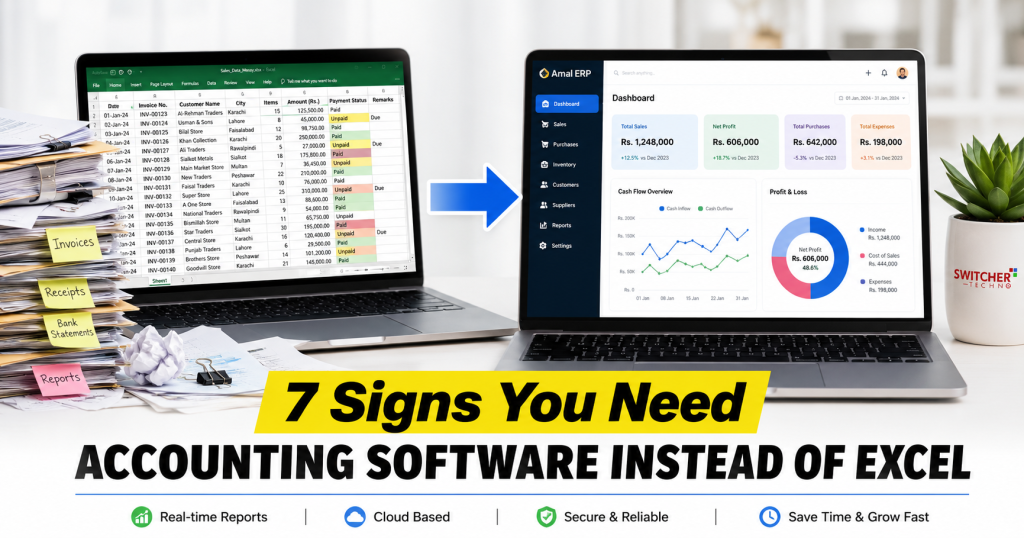
For years, Excel spreadsheets and handwritten registers were good enough for most Pakistani businesses. But as your business grows, there comes a point where spreadsheets stop saving you money and quietly start costing you — in lost time, errors, and tax penalties. This guide covers the 7 clear signs your business has outgrown Excel and is ready for proper accounting software.
When should you switch from Excel to accounting software?
You should move from Excel to accounting software when you have more than one person entering data, you sell on credit (udhaar), you carry inventory, or tax season turns into a multi-day panic each year. At that stage, the cost of errors and lost time is higher than the cost of the software itself — and with FBR digital invoicing now mandatory for registered businesses, manual spreadsheets can’t keep you compliant either.
Key takeaways
- Multiple users: When two or more people touch the books, Excel files conflict.
- Credit sales: Udhaar tracking gets forgotten in spreadsheets.
- Inventory: Stock and accounting drift out of sync in separate files.
- Tax readiness: FBR compliance and clean records can’t wait for year-end.
- Real-time view: You need profit and cash flow now, not weeks later.
The 7 signs your business has outgrown Excel
Below are the clearest signals — drawn from what Pakistani business owners actually run into as they grow. If three or more sound familiar, you’ve already outgrown the spreadsheet.
1. Finding your real profit takes hours every month
In Excel, your true profit is never sitting in front of you — you have to build it. You add up sales from one sheet, subtract expenses from another, remember the udhaar that hasn’t come in, and hope you didn’t miss anything. Accounting software shows your profit and loss in real time, ready the moment you open it.
2. Personal and business money are mixed in the same records
This is the single most common bookkeeping mistake among Pakistani SMEs — paying shop rent, the home electricity bill, and the supplier all from one account in one messy sheet. It makes your real profit impossible to see and your records useless when a bank asks for statements. Accounting software separates business transactions cleanly and categorises every rupee.
3. More than one person needs to update the books
Excel breaks the moment two people touch it — someone keeps a copy on their laptop, someone edits the “main” file, and within a week you have three versions and no idea which is correct. Cloud accounting software gives everyone access to one live record with role-based permissions, so your accountant, cashier, and you all see the same up-to-date data.
4. You sell on credit and lose track of who owes you
Udhaar is normal in Pakistani business, but Excel is a terrible place to manage it. Receivables get forgotten, follow-ups slip, and cash you’ve already earned sits uncollected for months. Accounting software tracks every customer’s outstanding balance automatically and can flag overdue payments — some systems even send WhatsApp payment reminders for you, directly improving your cash flow.
5. Inventory and stock valuation no longer add up
Once you hold stock, Excel can’t keep pace. Manual stock sheets drift out of sync with reality, and working out the true cost of goods sold — especially when purchase prices change — becomes guesswork. Inventory-linked accounting software updates stock with every sale and purchase, and values it correctly so your profit figures are real.
6. Tax season becomes an annual panic
If filing your return means digging through twelve months of scattered sheets the night before the deadline, your records aren’t tax-ready — and that costs you. Pakistani SMEs routinely overpay tax because legitimate expenses were never recorded and couldn’t be claimed. With FBR enforcement tightening and digital invoicing expanding across more sectors in 2026, clean structured books are no longer optional.
7. You’re making decisions on gut feeling, not data
The deepest cost of Excel is invisible: you can’t see your business clearly, so you guess. Which product actually makes money? Is this month better or worse than last year? Modern accounting software turns your daily transactions into dashboards and reports — profit trends, best-sellers, cash flow at a glance — so you decide on facts, not feeling.
Reality check: Most owners wait until a painful event — a tax notice, a stock loss, a loan rejection — forces the switch. Moving while things are still manageable means you migrate clean records instead of cleaning up a mess later.
Excel vs accounting software — a clear comparison
| Factor | Excel / Manual | Accounting Software |
|---|---|---|
| Real-time profit | Manual calculation | Automatic, always ready |
| Multiple users | Conflicting copies | One live shared record |
| Credit / udhaar | Easily forgotten | Tracked automatically |
| Inventory valuation | Drifts out of sync | Updated with every sale |
| Tax readiness | Year-end scramble | Organised year-round |
| FBR digital invoicing | Not possible | Built-in, real-time |
| Business insights | None | Dashboards & reports |
How to move from Excel to accounting software smoothly
Switching doesn’t have to be painful. A good provider helps you migrate without losing your history:
- Import existing data: Your past Excel records can be brought in, so you don’t start from scratch.
- Choose FBR-ready software: Pick a system with built-in FBR digital invoicing so compliance is automatic.
- Train your team: A user-friendly interface keeps training short and simple.
- Start with the essentials: Begin with invoicing and accounting, then add inventory, POS, and payroll as you grow.
Tip: If your business deals with sales tax, make sure your new software supports both FBR and SRB compliance — and can generate the sales tax registers you need at filing time.
How Switcher Techno can help
Switcher Techno offers cloud-based accounting software built specifically for Pakistani businesses — with FBR and SRB compliance, automated bookkeeping, real-time inventory, and detailed financial reports in one place. Our team helps you migrate your existing Excel data smoothly, so you move to the cloud without losing your history. If you run a retail or restaurant business, our POS software connects billing, stock, and accounting together. We also provide complete FBR digital invoicing support so every sale stays compliant. Already weighing your options? See why Pakistani businesses are switching from Excel to cloud accounting in 2026.
Ready to leave Excel behind?
Move your accounting to the cloud and stay FBR-compliant — without the spreadsheet headaches. Book a free demo today.
Book a Free DemoFrequently Asked Questions (FAQs)
Is Excel good enough for small business accounting in Pakistan?
Excel works for a very small business with few daily transactions and a single person managing it. Once you add staff, sell on credit, carry inventory, or need FBR-compliant records, Excel’s error risk and manual effort start costing more than dedicated accounting software.
What are the signs I need accounting software?
The main signs are: more than one person updating the books, tracking udhaar (credit sales), holding inventory, tax season becoming a yearly scramble, and making decisions without real-time reports. Three or more of these mean you’ve outgrown Excel.
Will I lose my old data when switching from Excel?
No. A proper provider helps you import your existing records from Excel or other software, so you keep your financial history and start with everything in place.
Can accounting software help with FBR compliance?
Yes. Good cloud accounting software comes with built-in FBR digital invoicing, automatically generating compliant invoices with QR codes and submitting them to FBR in real time — something Excel cannot do.
Is accounting software suitable for small businesses?
Absolutely. Cloud accounting is ideal for small and medium businesses in Pakistan because it reduces errors, saves time, ensures FBR compliance, and grows with your business.
Disclaimer: This article is for informational purposes only and should not be considered legal or tax advice. FBR rules and compliance requirements are subject to change. For your business’s specific obligations, please refer to the FBR’s official website (fbr.gov.pk) or consult a licensed tax advisor.
